In July 2023 a Kraków city office asked drivers to do something unusual: not to peel fake QR stickers off parking meters. Police were to secure the traces first, so the fraud stayed where it had been stuck — with an official request not to touch it and to report it by phone.
On 28 September 2026 the stickers came back. This time the Kraków Road Authority removed them at once, and the notice described the mechanism more precisely: the stickers were placed on information about the city app and led “to another, unknown app”, and anyone who scanned the code and entered card details was advised to contact their bank.
The owner of a clinic, workshop or salon reads this with a different question than a driver. Their QR code sits on the counter, two metres from the station. Does the same trick stand any chance there?
The same trick twice — three years apart
The repeat after three years matters more in this story than the incident itself. One sticker is an anecdote; the same method returning on the same devices in the same city means someone priced the cost and found it worthwhile. That cost is a printout and two minutes at the machine.
The backdrop is large enough. CERT Poland recorded 260,783 unique incidents in 2025 versus 103,449 a year earlier — up 152% — with 658,320 reports from users. Phishing accounted for 30% of incidents, not of reports, so about 78,000 cases. QR codes are one carrier in that set and have no separate statistical category — which is exactly why nobody in Poland can say how many of those 78,000 started with a scan.
The attack surface itself is growing, and fast. In a Kantar study for GS1 (N=1,000, people aged 18–70, November 2025) 82% of respondents know QR codes and what they are for, versus 64% a year earlier. 58% had scanned a code from a product package, versus 34% a year earlier. Scanning has become a reflex — and a reflex is the cheapest raw material in this whole craft.
QR payment security in numbers Poland does not have
The nearest hard measure comes from the UK market. In the twelve months to April 2025 Action Fraud took 784 quishing reports — fraud based on a swapped code — with total losses of £3.5 million. Car parks were flagged in that warning as especially exposed.
784 reports nationwide over a year is about 2.1 a day. For the heat this topic gets in headlines — not much. The more interesting second figure from the same set: divide losses by reports and you get about £4,460 per case on average. The parking fee that starts it all costs a few pounds in the UK.
That ratio is the whole mechanic. A hijacked parking fee is too small to pay anyone, and serves only as a pretext to harvest card data on a spoofed page. The charge comes later and is an order of magnitude different from the transaction the payer meant to make. The value of one payment is therefore not a measure of possible loss, and any risk account based on it is three zeros too low. As a check that the carrier matches, that same amount works perfectly.
Whose loss is it? NBP says 11 percent
Polish data on payment fraud scale is very good — and says something education campaigns usually leave out. In Q1 2026 the National Bank of Poland recorded 39,200 fraudulent transfers worth PLN 245.9 million. That is 56% more than the previous quarter and clearly above the prior record of just under PLN 177 million in Q3 2025.
Now the reference point without which those PLN 245.9 million scare harder than they should. Fraudulent transfers were 0.00249% of all operations by count, versus 0.00129% a year earlier. Up 93% — almost a doubling — yet still about one case in forty thousand transfers. The share by value moved in the same period from 0.00142% to 0.00245%, up 1.73× against a 1.93× rise in the count share. So there are more frauds.
Two other figures from that report are key for the carrier topic. 34,000 of 39,200 cases — nearly 87% — came from manipulating the payer. And second: banks bore a little over PLN 27 million from that pool, or 11% of losses. The remaining 89% stayed where the decision to approve the payment was made.
Cards look different in the same report: 84,700 fraudulent transactions worth PLN 21 million average about PLN 248 per case, versus about PLN 6,270 for a transfer. Card fraud is therefore more frequent and cheaper; transfer fraud is rarer and roughly twenty-five times more expensive. For a service business owner the takeaway is unpleasant but useful: risk moves to where a person makes the decision, and that is where it has to be disarmed.
Three conditions a swapped sticker must meet
Back to the counter. For the parking-meter fraud to transfer to a plaque in a clinic, three things must happen at once.
First: the code must be static — always leading to the same address, regardless of the transaction. A swap only makes sense when it replaces one fixed destination with another fixed destination.
Second: the payer must enter the amount. At a parking meter that is natural, because nobody but the driver knows how many hours the car will stay. A spoofed page can therefore ask for any amount without raising suspicion.
Third: a card-details form must sit at the end. That is the loot, as the UK account in the previous section shows.
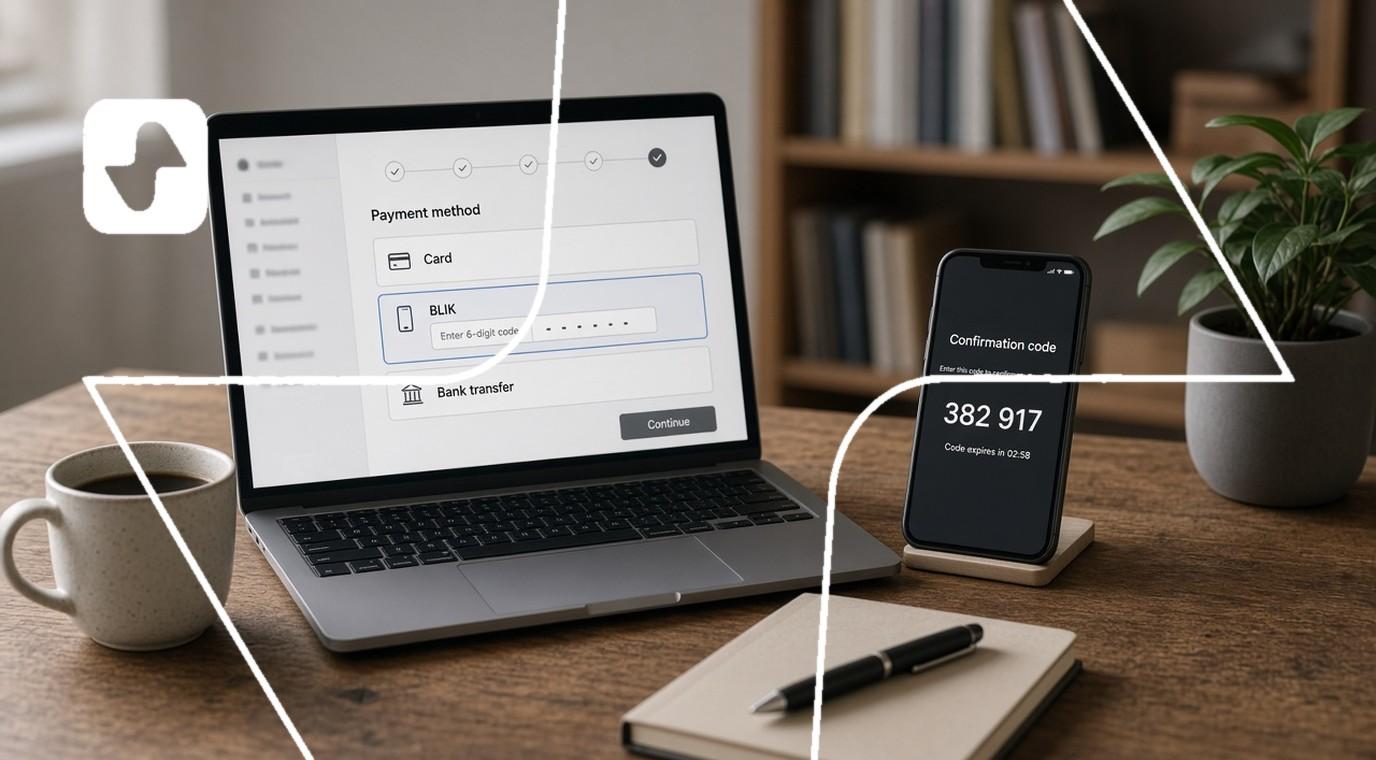
A model where the service provider sets the amount in their own app overturns conditions two and three. A salon client hears “one hundred eighty” at the counter, scans, and sees exactly that amount on their phone — or sees a different one, and then the conversation ends at the counter before anyone approves anything. Authorisation continues through BLIK, Apple Pay or Google Pay — through the bank app or the phone wallet — where nobody retypes a card number.
The Polish measure of that single layer has no gaps, either. BLIK cleared nearly 1.6 billion transactions in the first half of 2026, up 13% year on year, worth PLN 244.8 billion (up 18%), with 21.6 million monthly active users. Almost one in four of those operations (23.9%) happened at a physical point of sale. The habit of confirming payments in one’s own banking app is therefore built in Poland and does not need to be funded from scratch.
What this model does not solve
Three things in this account stay open — better to name them than pretend the carrier solves everything.
First, manipulation still works. Nearly 87% of Polish transfer frauds in Q1 2026 came from manipulating the payer, and you can manipulate by phone, SMS, messenger and a spoofed page. Whoever convinces the payer to approve an operation gets that approval in any app, including their own bank app. A dynamic amount makes an attack on the carrier harder; an attack on the person is untouched by that change.
Second, the confirmation screen is the last moment when the payer can see that the money is going elsewhere — and nobody has publicly collected how exactly each Polish bank describes the recipient there.
Third, a counter plaque is a different carrier from signage in public space. A sticker on a parking meter is fixed, twenty-four hours a day. A plaque at a station is protected by the presence of the person who stands behind that station.
In Paymove’s Scan&Pay solution every code is unique and leads to a specific service at a specific merchant, and payment methods are limited to BLIK, Apple Pay and Google Pay.
QR payment security at the counter: a five-second test
For a service firm that yields one operational action. Once a day at opening, look at the plaque and check two things: that nothing is sitting on it, and that the amount the first client’s phone shows matches the amount entered in the app. Agreement of those two numbers is the only proof the code belongs to that counter.
The cost asymmetry clearly favours the service provider. A fraudster must print a carrier, enter the premises and swap it in front of someone who works there. The owner must glance at their own counter once a day. In public space that asymmetry runs the other way: nobody stands there, the device waits all day — which is why stickers return to Kraków parking meters on a three-year rhythm.
QR code risk is therefore a function of where the code hangs and how many people look at it. It is priced in minutes of attention per day. At the counter that account is short.