“We’ll make our own QR codes.” That sentence comes up in venue conversations often enough that it made our list of standard sales objections, next to “we already have a ticketing system” and “we’re too small”. It sounds reasonable. A code generator runs free in the browser, a printed plaque costs a dozen zloty, and the venue’s IT person can do it after hours.
The square really is free. A QR code is a pointer — a graphic with an address encoded inside. Whether a scan becomes a transaction depends only on what waits at that address, and that already costs money. The bill arrives as unsold tickets, so it never appears on any invoice and nobody at the venue books it.
The barrier is not on the visitor’s side
Technology can be set aside at once. In a Kantar study for GS1 Poland, 82% of respondents have encountered QR codes and know what they are for. 58% had scanned a product-packaging QR to learn more — 24 percentage points fewer. So the gesture is mastered, but in an informational scenario: the study measures scanning for knowledge, not for payment.
On payment expectations the data are just as clear. A Polska Bezgotówkowa Foundation study from June 2026 finds that 61% of Poles rate the ability to pay by card or phone at tourist attractions as important or very important. In food service 63%, at car parks 56%, at equipment rentals 51%. “Consumers increasingly treat cashless payment as a standard they also expect on holiday trips,” commented Monika Grabowska, managing director of the Foundation.
A declaration about a standard means little until you set it next to a figure from another study by the same foundation: 46% of respondents had already abandoned a purchase because they could not pay the preferred way (November 2025). The question covered shopping in general, not tickets, but nearly half the sample has lived a moment of putting something they wanted back.
The scale this plays on in Poland is non-trivial. According to Statistics Poland, museums drew 46.2 million visits in 2025, up 4.2% year on year. 14.1 million entered free; 7.4 million on a concession ticket. Even after subtracting both groups, more than 20 million paid entries remain — museums alone, without zoos, amusement parks, seasonal sites and extras sold on the grounds.
If visitors can scan, expect cashless payment and arrive by the million, why does a code hung by the venue so often end as a plaque nobody uses?
Reason 1. The code opens a website — and payment is still five steps away
The most common own-code scenario: the scan opens the venue site or a ticketing-system shop. The visitor lands on the homepage, hunts for the right ticket, picks a variant, goes to the cart, then to a form.
Baymard Institute has measured that stretch for years. In its 2024 measure the average checkout had 5.1 steps from cart to review and 11.3 form fields, though — by Baymard’s own account — eight would be enough for most stores. Field count falls slowly (11.8 in 2021, 12.7 in 2019); step count has barely moved since 2012. And it is field count, not screen count, that most damages the purchase experience.
Anyone who sells online knows the aggregate effect: Baymard’s average cart-abandonment rate across 50 independent studies is 70.22%. Fewer than three in ten complete. In e-commerce that is tolerable, because an abandoned cart can be recovered by email or remarketing. At a physical attraction there is no second chance: the visitor stands at the entrance with a child beside them and a queue behind, and in two hours they leave for good.
Among abandonment reasons Baymard notes 17% pointing to a purchase process that is too long and complicated. The measure covers US online shoppers — on a path opened in a queue there is no reason to think that share would be lower.
Reason 2. The path requires an account nobody will create for one ticket
A forced account signup collected 18% of Baymard mentions — fourth on the list, just after extra costs (40%), slow delivery (20%) and distrust about entering card details (19%). An online store can accept that, because it builds a base of returning buyers. A museum selling a ticket to a temporary exhibition builds no such base.
A still costlier version is a code that opens the App Store or Google Play. App install adds download, permissions and registration — where the visitor wanted to pay twenty zloty for a ride. An app pays back in a repeat relationship; for a one-off attraction ticket there is nothing to amortise.
Reason 3. The method this person actually pays with is missing
In the same study 19% of abandonments fall on distrust of entering card details, and 9% on too few available payment methods. The sources differ — someone may distrust the form while ten methods are offered — but for the venue the outcome is one: the path ends on a field that assumes the visitor will pull out a card and type sixteen digits while standing in the sun.
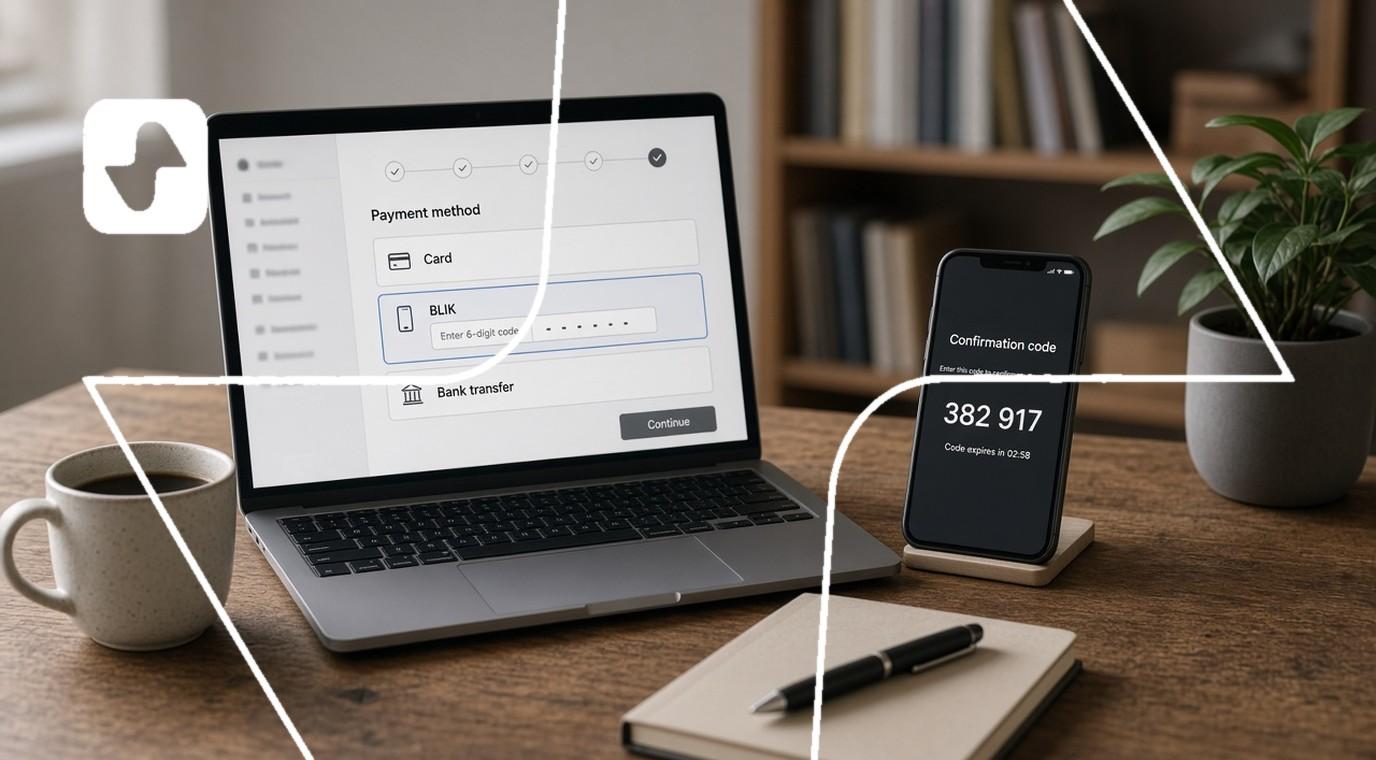
Polish figures show what that form competes with. In the first half of 2026 BLIK handled 1.6 billion transactions with 21.6 million active users — 8.7 million a day on average. The same person who pays online with a six-digit code in two moves gets a card form or an account number to retype at the venue plaque. Nobody needs to explain the comfort gap — they feel it and walk away.
Reason 4. The page behind the QR was designed for desktop, opened on the move
Own codes usually lead where the venue already has something: a website or a sales system built as a desktop service with a responsive overlay.
Contentsquare data cited in this year’s Shopify roundup show the split: mobile devices account for about 70% of e-commerce traffic and convert at about 2% versus 3.4% on desktop. That is global e-commerce, not on-site ticket sales — with the difference that a QR code generates no desktop traffic at all, so the venue works only on the weaker half.
Load speed adds a measurable cost. In a Deloitte and agency 55 study for Google, across 37 large brands and more than 30 million sessions from late 2019, a 0.1-second improvement in mobile page load accompanied 8.4% higher conversion in retail and 10.1% in travel. It is a correlational, logarithmic model, so the effect must not be multiplied by every tenth of a second saved or transplanted straight onto a Polish cultural venue. But a venue page loading on a phone with weak signal in a park sounds like a real problem.
Reason 5. Nobody knows which step people drop off at
A ticket desk gives the venue one true number a day. An own QR code gives none until someone sits down to analytics and builds a funnel: scans, page entries, add-to-cart, started payments, paid.
Without that measure the venue sees an aggregate result — “little sold through the code” — and draws the simplest conclusion: QR codes do not work. Then it goes back to the desk and hires another seasonal staffer. The answer sits in one of five funnel steps, and without a stage breakdown you cannot say which.
The 70.22% e-commerce benchmark is not the reference here, because it also includes browsers who were only looking, and nobody scans a gate code just to browse. The venue’s reference is its own funnel from a month ago. That is the first thing to do, before anyone talks about changing provider.
A sixth reason I am not counting here
The carrier is a separate category. A paper print or sticker can be covered, damaged or swapped, and a visitor who has heard of quishing simply will not scan a shoddy plaque. That deserves its own piece, because it also affects venues on ready-made solutions, and it is fairer to describe it separately than to paste it here as a paragraph.
The bill for an own QR code has one line with no price
The cost argument for own codes usually goes: the plaque costs a dozen zloty, and the system is a subscription. The bill looks different once you add labour. Who at the venue will cut checkout to eight fields, who will connect BLIK and wallets, who will look at the funnel each month and who will fix what the funnel shows? What does that time cost across a whole season? For scale on the other side: the Pay&Go page compares a ticket machine priced at about PLN 45,000 a year with a QR board at about PLN 250 a year. That 180× difference describes hardware only; work on the purchase path sits outside that account and, with an own code, falls entirely on the venue.
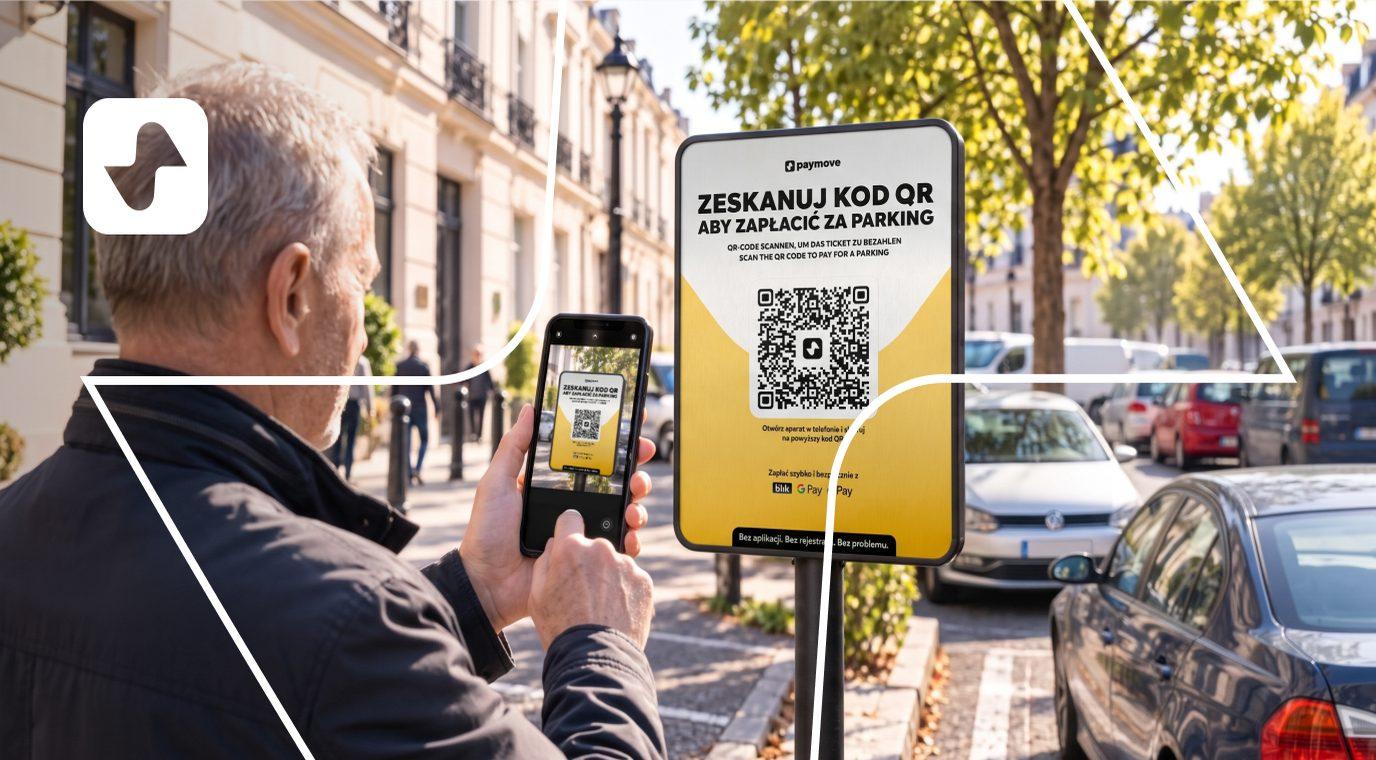
With Paymove the path looks like this: the visitor scans the code with the phone camera, picks an item and pays with BLIK, Google Pay or Apple Pay, without installing an app and without creating an account. The whole flow takes under 20 seconds from the scan. The Pay&Go page cites 150,000 transactions a month across 200 sales points in Poland — about 750 payments per point per month, a volume at which a funnel can actually be measured. “Visitors gained a convenient alternative to the ticket desk,” says Justyna Badaszko of Gdańsk Zoo, one rollout of this line.
Garden of Lights had its own QR codes before switching to Paymove codes — the reason was a longer purchase path and worse conversion. On top of that one should add staffing cost: the QR code delivered at least PLN 7,000 monthly savings per location, or PLN 84,000 a year.
A venue that hangs its own code is really deciding what happens between scan and payment: whether that stretch has an owner in the organisation and a number in the report. When it does, an own code can work and is worth measuring before anyone proposes a replacement. When it does not, the plaque stays on the wall as signage, and sales return where they were: to the desk that scales with headcount.