An office that launches or expands a paid parking zone usually gets three cost comparisons. One counts device price, the second commission on turnover, the third carrier cost. All three are true and none can be set against the others, because each measures a different unit.
That is why the dispute over which fee-collection channel comes out cheaper usually ends in a draw of declarations. To settle it you must answer two questions those comparisons omit: how much one collected fee costs, and who really pays for it.
A parking-meter price means one thing in Muszyna and another in Krynica
Start with the channel whose cost is best described, because it hangs in tenders. Our own calculator on the Mobility subpage prices the first year of one parking-meter location at PLN 30,000: PLN 25,000 purchase, PLN 2,000 service and maintenance, PLN 2,000 terminal, PLN 1,000 management.
That figure impresses only when set next to real zone revenue, not next to a competing bid. Muszyna collected from paid parking PLN 55,600 in the first half of 2026. One parking meter in year one is therefore 54% of what the whole zone took in six months. In Krynica-Zdrój, where three peak-season months of 2026 gave PLN 424,600, the same parking meter is 7.1% of revenue. The same device price, two entirely different investment decisions.
The practical conclusion: device price says nothing about profitability until you know zone volume. And volume in Polish zones is rarely published.
How many fees a day must a parking meter handle to come out cheaper than a QR code?
A common denominator is needed, and it is channel cost per collected fee. To calculate it you need the average parking-fee value, and that figure is rare. The fullest was published by Kraków City Roads Authority: in 2021 mobile payments in the Kraków zone were 3,903,271 transactions worth PLN 25.2 million, or on average PLN 6.46 per transaction. The figure is five years old and covers one city and one channel, so I treat it as an order of magnitude, with the caution its age requires.
Now both channels in the same unit. On the parking-meter side cost is fixed: about PLN 5,000 a year for maintenance, service and management, and with purchase spread over ten years PLN 7,500. On the QR-code side cost has two parts: PLN 250 for the board, PLN 1,200 a year management, plus 3% commission per transaction, or PLN 0.19 at an average fee of PLN 6.46.
That pairing produces something neither our subpage nor a hardware vendor’s offer shows.
A zone collecting 5,000 fees a year, or 14 a day, pays 48 gr per fee for the QR channel and PLN 1.50 for the parking meter. The QR code is three times cheaper here. At 20,000 fees a year, 55 a day, the gap nearly vanishes: 27 gr versus 38 gr. Above 31,200 fees a year, or 86 a day, the order reverses and the device becomes cheaper per unit, because its fixed cost spreads over enough transactions to stop mattering, while our commission grows linearly with turnover. At 50,000 fees a year the parking meter costs 15 gr per transaction and the QR channel 22 gr.
So QR-code advantage is an advantage of a small and mid-size zone. In a large-city centre the cost argument on our side weakens and what remains is the driver-convenience argument, which is real but of a different nature.
Independent confirmation of the order of magnitude comes from Poland’s largest zone. Warsaw Municipal Roads Authority director Łukasz Puchalski said in March 2024 that the cost of handling a payment at a parking meter is nearly 20 times higher than the cost of a mobile payment. That ratio is calculated at Warsaw volume and covers handling the transaction itself; the device with its full fixed cost enters the bill separately. Both bills speak to the same dependency from two sides: a device stops being expensive when it has something to do.
The channel that costs the city least costs the driver most
Here begins the part supplier comparisons omit most often, because it falls unfavourably for everyone except the parking meter.
Parking apps today serve hundreds of zones in Poland, so the experiment stage is behind them. In July 2026 you could pay with them in 233 cities, and the five largest operators covered 58 to 144 cities each, with year-on-year growth of a dozen to several dozen municipalities. For the office that is a channel with no hardware investment, and unit cost sits on the driver’s side as a fee added to the parking price.
The size of that fee is where the office has no control over it — in the operator’s fee table. One operator active in Polish zones until now charged 95 gr for additional services, and from 26 October 2026 its new terms allow a percentage model, with an example of 15% of parking value, or PLN 3 on a PLN 20 stay.
Convert that to the same unit as earlier. A 95 gr fee at an average stay value of PLN 6.46 is 14.7% of the fee value, five times our commission calculated on the same amount. The percentage model from the example would give 97 gr on that average — practically the same — so the change is neutral on a short stay and costly on a long one. From the office’s point of view nothing changes, because it is not their money. And that is exactly why this cost drops out of every official comparison, even though in a resident’s pocket it is the largest item of the three.
What happens to the digital channel in the oldest age group?
Every cost comparison silently assumes the resident has a way to pay. CBOS measured that in May 2026 on a sample of 1,041 people: the internet is used at least once a week by 82% of adult Poles, 77% aged 55–64, 62% aged 65–74 and 37% over 75.
The study measures internet use, without asking about a smartphone or the ability to pay for parking, so for a payment channel it only sets an upper bound of possible reach. The direction of the conclusion remains unambiguous and applies to apps and QR codes to exactly the same degree. Two of three channels are unavailable to part of the oldest group, and city-centre zones also serve traffic to offices and clinics.
From that follows a constraint that is not a design issue but a legal one: the road manager must ensure a real possibility of paying the fee in cash. No device-free variant lifts that duty, so the “parking meter or QR code” question in a public zone is posed falsely. The real choice is how many devices remain in the zone.
Our own bill and two things it omits
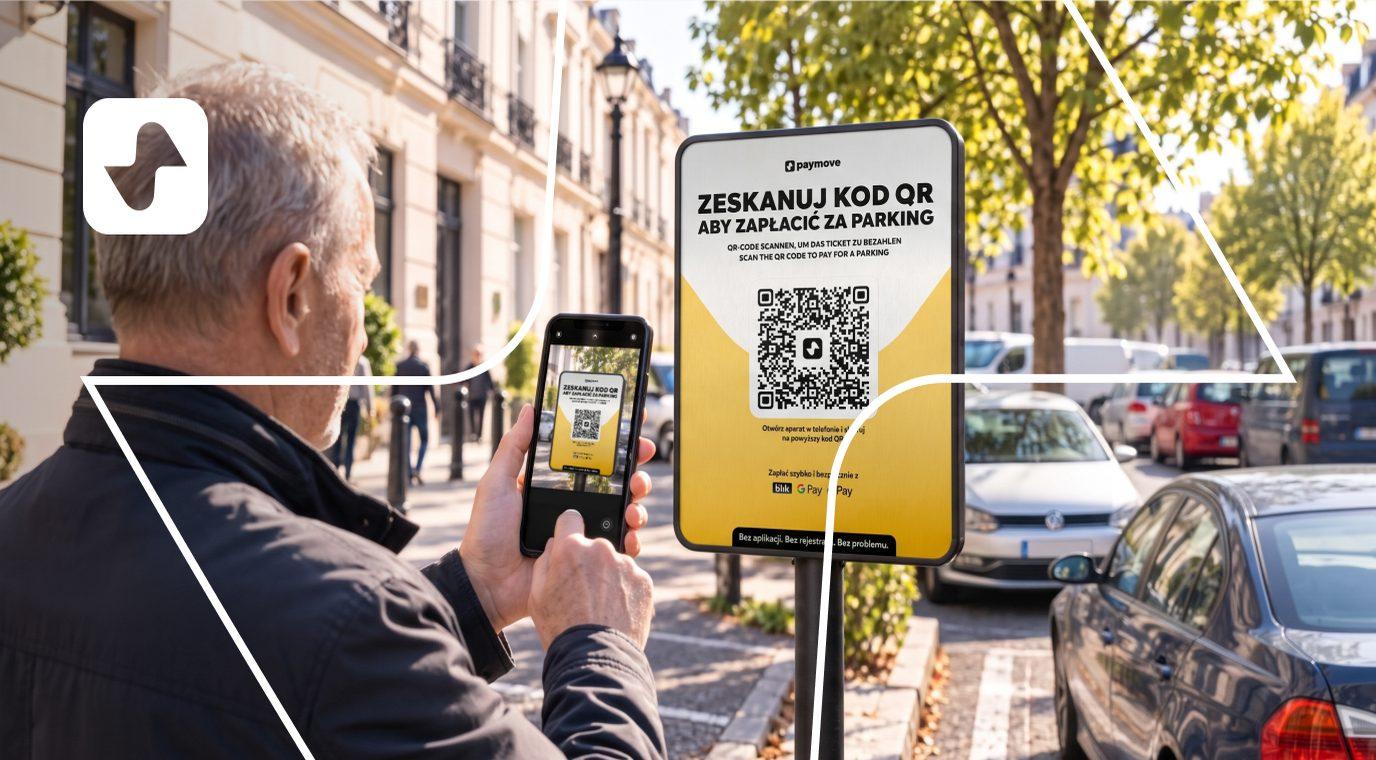
Now our side of the comparison, with caveats, because without them it would be a sales insert. In the Mobility line we place a QR-code board and take 3% per transaction, at PLN 250 for the board and PLN 100 a month for management, which in year one of one location gives PLN 1,450 versus PLN 30,000 on the parking-meter side.
Two things this bill does not cover that decide its value for the office.
First: carrier density. A parking meter serves several dozen spaces from one point, and a board must be in sight of someone leaving the car. The number of carriers in the zone will therefore not equal the number of removed machines, and our “one location versus one location” pairing does not show that. If five boards must replace one parking meter, annual fixed cost on our side rises to PLN 7,250, breaks even with the parking meter already at 1,300 fees a year, and the whole cost advantage vanishes. That is the most important question an office should ask us before signing a contract.
Second: commission does not appear in this comparison at all. 3% of a zone with PLN 111,000 annual revenue is PLN 3,336, and of a Krynica-sized season PLN 12,738. That is the same order as device-maintenance cost, and a carrier-only pairing ignores it. On the parking-meter side a symmetric item is missing from this bill — commission on card payments — because the PLN 2,000 in our calculator covers the terminal as a device.
Parking fee collection systems are compared only after volume is stated
From these figures one boundary emerges, sharper than either side’s offers suggest. Below roughly 50 fees a day a device has no economic case and the digital channel will be clearly cheaper. Above eighty-six the parking meter’s unit cost falls below ours, and at five boards per machine the boundary sits even lower. Between those values the gap is small enough that convenience, accessibility and whether a cash-capable device must stay in the zone anyway decide.
The problem is that most Polish zones do not know which side of that boundary they sit on. They publish revenue, almost never transaction counts by channel, and without those a cost conversation is a conversation about catalogue prices.
So an office comparing offers today has four figures to enter in a table that none of the offers contains: fees per day in the worst month of the year, the same figure at peak season, average value of one fee, and the size of the add-on fee a resident will bear in each variant. The first three sit in its own settlement system. The fourth it must demand from the supplier.
—