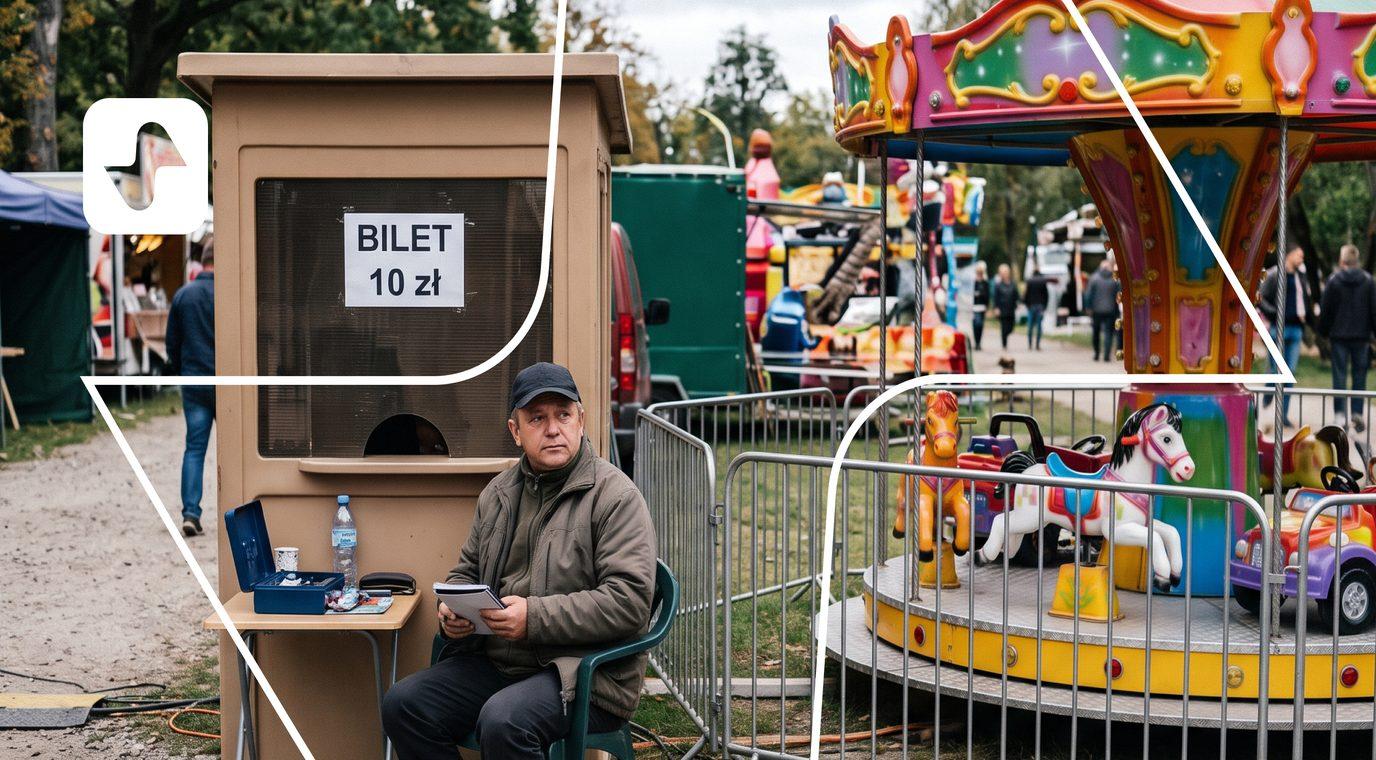
An electric bus carries visitors around Gdańsk Zoo from May to September. The short route costs PLN 30, the long one PLN 35, departures every half hour. The stop and ticket sales point sit at the main entrance — that is how the garden itself describes it. Admission in high season costs PLN 45, so the ride alone is 67 to 78 percent of the entry price.
Elephants and giraffes are deeper inside. Someone who walks to them on foot and only there decides they would rather ride farther has to go back to the gate. How many people give up at that moment nobody knows — I found no such measure for Polish venues. What can be counted is the other side of that bill: how much it would cost to put a payment point where the decision is made.
In museums most of own revenue is made away from the ticket desk
The best breakdown I found for Polish cultural institutions comes from an analysis prepared for Museum Statistics. Ticket sales account there for about 41% of own revenues. The second item is publications (23–24%), then education (13–14%), room hire (10–11%) and other (7–8%).
The rest also includes items that have little to do with on-site sales: room hire, and partly publications distributed externally. Even after subtracting hire, about 43–46% of own revenue remains that arises somewhere by the exhibition, the shop, the workshop room — places where usually nobody stands who could take money.
The gap by institution type: in state museums tickets give 60.4% of own revenues, in local-government ones 39.9%. The weaker the ticket stream, the more the institution hangs on what it sells beside the ticket.
Two things to say with that figure. The analysis covers 2016–2018 and a sample of 138 institutions, so it has age — I found no newer structure breakdown. And own revenues are on average a little over 14% of all museum revenue; the rest is subsidies. We are talking about the majority of a small slice of the budget.
How much must a point sell to keep the person standing in it?
The minimum-wage regulation for 2027 went into the Journal of Laws in September; trade press covered it on 22 September 2026. The rate will be PLN 4,950 gross, PLN 144 and 3% more than in 2026. Full employer cost is PLN 5,963.77 a month. Annually — PLN 71,565 for one person on the national minimum, without PPK.
A seasonal venue does not pay for twelve months. The May–September season is five months and 153 days, or PLN 29,819 for one FTE. I count that variant further, because it is the gentlest for a sales point: one person will not cover ten hours a day for 153 days, so real staffing is two FTEs and every threshold below has to be doubled.
How many transactions must pass through such a point for it to pay for itself:
- an attraction at PLN 30 — 994 transactions a season, or under 7 a day;
- an attraction at PLN 10 — 2,982 transactions, or 19.5 a day;
- an attraction at PLN 5 — 5,964 transactions, or 39 a day.
I count on revenue alone, which further softens the bill: on the venue’s own service margin is often high, but on resale of anything the threshold rises in proportion.
Nineteen and a half transactions a day in a venue taking 3,000 people is 0.65% conversion — a result that makes itself. At 800 visitors it is already 2.4%, and at 200 people a day — 9.75%, doubled to 19.5% if the point is staffed with two FTEs. The same attraction, the same price, the same person cost, and required sales effectiveness diverges fifteenfold. A large venue will put a stand by the enclosure and not even check whether it pays; a small one knows in advance that every tenth person would have to buy. The arithmetic also assumes one transaction per person — on family sales, where one purchase serves three or four people, required effectiveness counted in visitors is correspondingly lower.
At thirty zloty a staffed stand pays for itself easily. At ten the threshold triples, at five it sextuples. The cost of staffing a point therefore sets the floor of what may be sold there at all. Feeding a goat for PLN 5, a workshop for PLN 8, a souvenir for PLN 12, a donation of any amount — all of that drops out of the catalogue not because nobody wants it, but because it will not keep the person standing next to it.
Cash stayed with small change, and that is exactly where it is fleeing from
The NBP study “Payment habits in Poland” (September–October 2023, sample 1,225) finds cash was used for 40.2% of transactions but only 28.1% of their value. Cash thus became a synonym for small change. Another reading confirms it: 53.6% of respondents named PLN 20 as the amount below which they prefer cash, and 49% try to carry PLN 50 to 200 on them.
The direction of change shows in a newer measure. According to a POLASIK Research study for the Polska Bezgotówkowa Foundation, reported by cashless.pl on 16 June 2026, in 2025 71% of payments at retail and service points were cashless, and NFC mobile payments grew to 24% from 18% a year earlier. In food service 85% of respondents now assume they can pay cashless — in the older 2018 reading 63% thought so.
The two figures must not be lined up: NBP measures all payment transactions by diary method, POLASIK only those at retail and service points. The difference between 40.2% and 29% must not be read as an eleven-point drop. What they share is direction; scale cannot be derived from the two measures.
For a point without a payment device the conclusion is the same in both readings: it cuts off the part of guests who stopped carrying small change, and small change is exactly the price band of add-on sales. Meanwhile the group that assumes up front they will pay by phone and only checks that in front of an empty counter is growing.
There is also evidence that when the cash barrier disappears, the basket itself grows. In Cantaloupe’s micropayments report (2024 data, two years old) the average cashless transaction in a vending machine was USD 2.24 versus USD 1.78 with cash, almost 26% more; cashless took nearly three quarters of transactions. And a vending machine is the closest analogue of an unstaffed sales point.
PLN 45,000 a year or 250
The second way out of the problem is a device instead of a person. The cost of a ticket machine is on the order of PLN 45,000 a year versus about PLN 250 a year for a QR-code board — a 180× difference, and the device stands in one place while you can put as many carriers as there are decision points in the venue.
At a PLN 250 carrier the threshold from the previous section falls for a PLN 10 attraction to 25 transactions over the whole season. One hundred nineteen times fewer than with a staffed stand.
The season lasts three months, the FTE twelve
It shows sharpest in seasonal attractions, and those are growing in Poland. Pumpkin cultivation area passed 10,500 hectares in 2025 versus 5,000 in 2020 — a doubling in five years. Part of that growth is farms whose product became admission; what part is unknown, because area is agricultural data. Dyniowa Farma in Łabiszyn takes PLN 40 per adult and PLN 20 per child for a season from 1 August to end of October; Dyniowa Planeta in Kielce PLN 25 for September–October.
A three-month season at two FTEs is PLN 35,783 to staff one point. A corn maze priced at PLN 10 would need, at that staffing, 3,578 entries in 92 days, or 39 a day. The owner of Dyniowa Farma tells Strefa Agro that costs “depend on weather, yields and material prices.” FTE cost runs the same in rain and sun, with a harvest and without.
Arithmetic therefore explains why a second sales point in such venues is usually invisible — though how many venues that covers, nobody has counted.
The dearest items in this bill are attractions the venue never priced, because it knew in advance it had no way to sell them. Cost-side figures are hard: we know the rate, the days and the threshold. Revenue side remains an estimate. And it will stay that way until someone measures how many visitors would buy an add-on attraction if they could pay at the place where the decision is made.