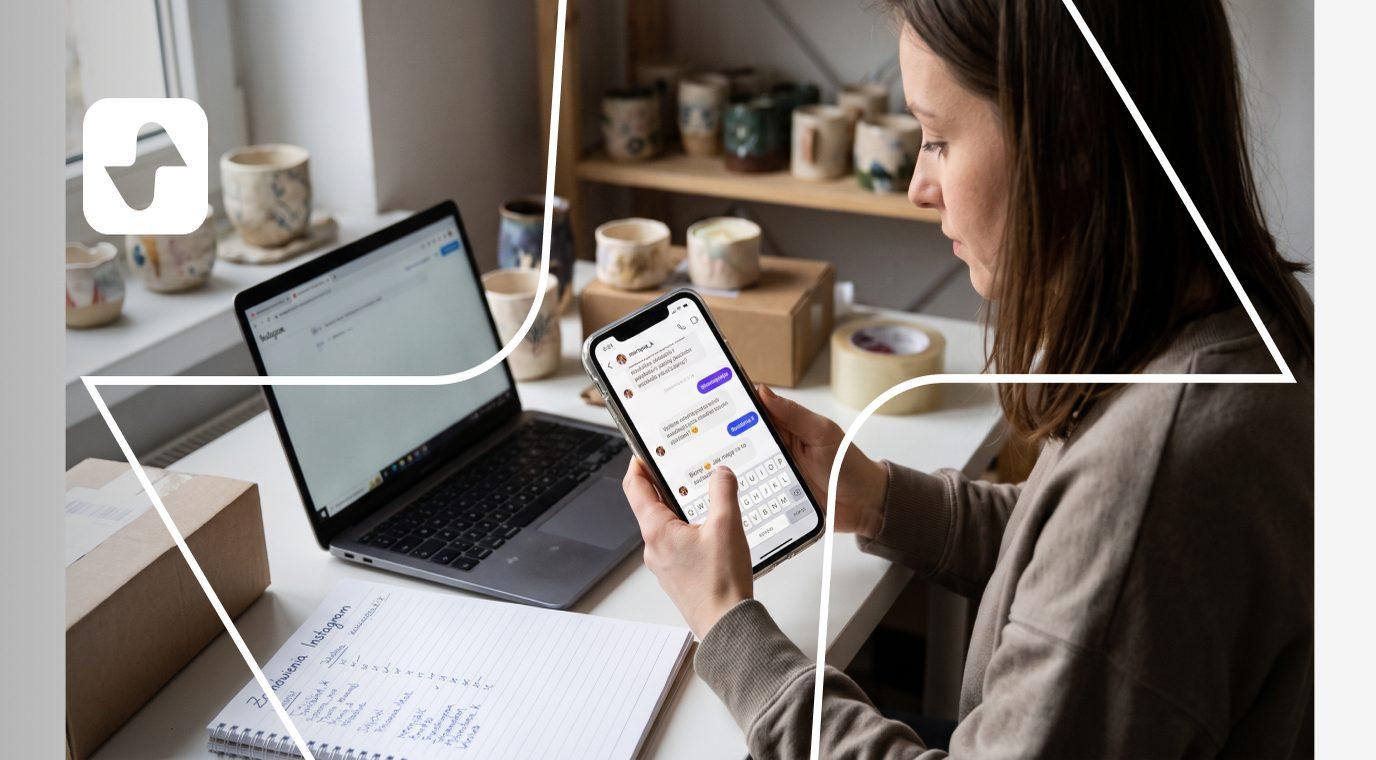
“I’ll take those two. What number should I transfer to?”
Two seconds of typing and the sale is practically closed. Practically, because now the seller pastes an account number into the chat window, adds the amount, asks for a transfer title so they know who paid, and then every few hours checks banking. The app that brought the customer all the way to the word “I’ll take it” takes no further part in that transaction from that moment.
How much of that sales is there in Poland? The answer depends on which report from this year you open.
Taking payments in social media: four figures for one phenomenon
The “Omni-commerce. I buy conveniently 2026” report by the Chamber of Digital Economy gives three different magnitudes in one document. “Purchases in social media were confirmed by 15% of respondents.” Social media as the place of the last purchase is named by 13% (“every 8th respondent”), the same as shop and brand mobile apps. And in the same material: “45% of Poles made a purchase directly on a social platform.” The report writes “Poles,” though the sample covers internet users, so read it more carefully as 45% of respondents.
A fourth figure is added by Gemius in “E-commerce in Poland 2026,” published 30 September. Social media is used by 90% of surveyed internet users, and a purchase directly through a social platform in the last year was made by 20%
. The lowest reading is 13%, the highest 45% — nearly three and a half times more. Subtracting those shares from each other would be a fake measure, because they do not sit on one scale. Each of those figures is probably correct, because each answers a different question: a purchase declaration in general, naming the last-purchase channel, a purchase directly on the platform. None answers the question that interests the seller: where in all that the money passed. “Purchase on a social platform” in these studies covers both clicking an ad and paying in an external store, and agreeing a price in a private message and a transfer to an account.
Two figures from the same e-Chamber report show what in this category is well measured. An influencer recommendation prompts a purchase by 66% of consumers, and 35% watched a live-shopping stream. Purchase intent in social media therefore has four scale readings and two source descriptions, at least in respondents’ declarations. How the seller took the money for it is described by none of them.
Why is there no till in Polish Instagram?
Instagram Shopping has been available in Poland since 2020: you can run a shop in the profile, tag products in posts, Reels and Stories. What Polish Instagram does not have is Instagram Checkout — payment inside the app. Meta has not given a launch date for Poland. In shop settings a Polish seller has one option: “Checkout on another website,” after which the customer leaves the app for an external site.
That gap has a date and a reason. In 2023 Meta withdrew from most markets shops with payment completed inside the platform, leaving shops with external redirect in 21 countries, including eleven European ones. Poland was not on that list. A caveat is needed here, because sources diverge: Polish materials from 2026 describe the in-profile shop and product tagging as working, while 2023 notices announced withdrawal of both. What is certain is what can be checked in settings today: in-app payment in Poland does not exist, and since 2023 nothing has reversed that.
Platforms see, meanwhile, where money really changes hands. In August 2026 trade media described TikTok work on sending money in a private message, accepted with one tap. That signal is worth reading carefully, because it is easy to over-interpret. The described feature handles a transfer between two private persons. It therefore streamlines exactly the act the seller from the opening performs by hand today, and the scope ends there: no confirmation for the buyer, no transaction status and no merchant settlement in it.
What does a transfer agreed in chat lack?
The instrument is available and widespread. BLIK in the first half of 2026 handled 1.6 billion transactions worth PLN 244.8 billion with 21.6 million active users. Of that in the three largest categories: e-commerce payments 766.7 million transactions for PLN 124.5 billion, phone transfers 393.6 million for PLN 67.6 billion, terminal payments 378.8 million. Average transaction comes out at PLN 162 and PLN 172 respectively, so a person-to-person transfer is on average nearly 6% higher than an online-store purchase. 20.7 million people registered for phone transfers, or 96% of all active BLIK users.
That second average is interesting and not much should be drawn from it. The company does not publish what share of phone transfers is paying someone for goods or a service versus splitting a dinner bill, so the sentence “part of sales hides in P2P transfer statistics” stays at hypothesis level. What is certain is the pace: 393.6 million operations in 181 days is nearly 2.2 million transfers a day.
There is one more figure that describes the conditions in which that transfer is to happen. According to Gemius 58% of buyers finish purchases on a phone, and 44% of them in an app. A transaction agreed in a private message therefore starts on a screen a few centimetres wide, and to close it the buyer must leave the app, open banking, paste a twenty-six-digit account number, retype the amount and invent a title. That is five acts, each with its own drop-off moment, all on the side of the person who already said “yes.”
From that list of acts the most important thing is still missing, because nobody performs it: establishing the transaction state. Paymove documentation describes seven payment statuses and a webhook that informs the seller’s system of every change, and that is today the standard of the whole payment-gateway category. A transfer agreed in chat has one status and it reads: the seller refreshes the banking app. The moment sales moves from “promised” to “paid” depends on whether someone looked into that app.
A request for a transfer in a message looks like what CERT warns against
The other side of the same transaction has its own reason to hesitate, and that reason is counted. CERT Polska in its 2025 report, published 8 April 2026, gives 658,320 reports and 260,783 unique incidents; unique incidents rose 152% year on year. Computer fraud is 253,238 cases, or 97% of all incidents, versus 95% a year earlier — 2 percentage points more. Phishing alone was about 78,000 events, almost one third of the total. Most often trade platforms were impersonated: 28,462 events with OLX branding and 22,513 with Allegro branding.
The same team’s monthly report gives current scale. In February 2026 alone: 5,600 incidents linked to data-phishing attempts, 16,900 harmful domains on the Warning List and 38,200 blocked SMS messages. Documented campaigns include trade platforms and Facebook.
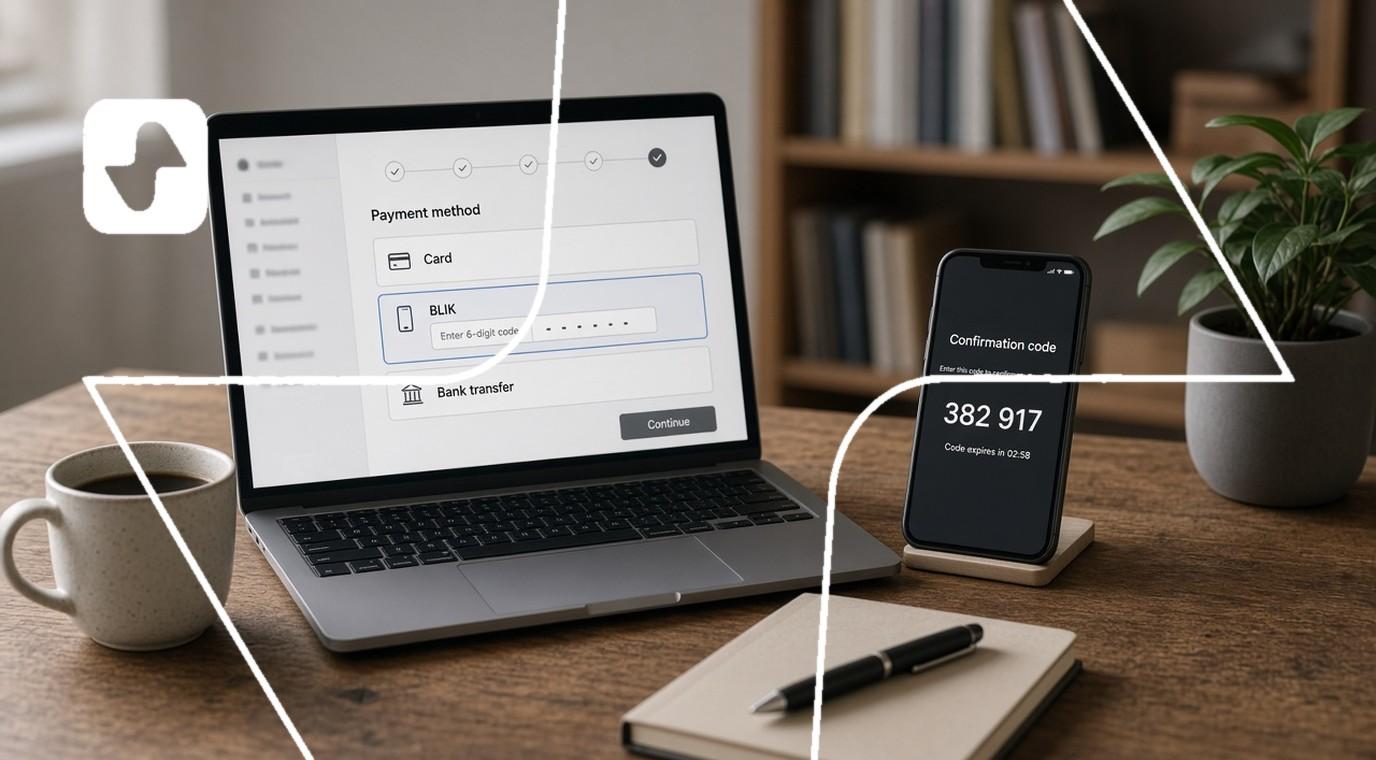
Those figures yield something very practical for a social-media seller. The buyer today has a reason not to trust a transfer request arriving in a message, and that reason has six-digit scale. An account number pasted in chat has no technical feature that would distinguish it from what banks and CERT warn against: it is a string of characters in a chat window. By comparison: BLIK is used by 67% of online buyers, and 53% of all buyers name it as the method used most often. The mechanics matter here: confirmation is shown by the buyer’s bank app.
How much does taking that payment another way cost?
The bill can be done on figures already used in this text. Average BLIK e-commerce transaction is PLN 162. The price list published on the Paymove Checkout subpage gives 1.29% per transaction at PLN 0 activation and PLN 0 subscription, which on such a basket gives PLN 2.09. A reference point for that amount: the minimum hourly rate in 2026 is PLN 31.40 gross, so PLN 2.09 equals four minutes of work. Handling one payment agreed in chat — pasting the number, checking the inflow, replying and logging the order — must fit under that threshold for the “free” version to be truly cheaper. How long that handling takes in Polish micro-firms nobody has measured.
Fairly one must add the profile where the arithmetic flips. At a PLN 1,000 basket the transaction fee is PLN 12.90, and a manual transfer carries no commission; its cost sits in the minutes counted a paragraph above. Whoever sells rarely and dearly, and every payment arrives anyway, gains nothing from a change beyond peace of mind. The advantage of a solution without fixed fees works in the opposite profile: many small transactions, an uneven month, a season followed by a month with no sales and no bill to pay.
Paymove enters this scenario on one layer: a payment link or QR code that can be pasted into a message, a profile description or a Story, with payment among others by BLIK, which the mentioned 67% of online buyers use. Beyond the rate itself three things matter for the seller. First: the payment page is generated from a product description, without a plugin and without a store. Second: confirmation is issued by an entity supervised by the KNF as a Small Payment Institution, to the PCI DSS standard. Third: it can be launched next to the current operator, without terminating a contract.
Meta has not given a launch date for in-app payment for Poland, and the feature TikTok is working on handles transfers between private persons. The moment after the word “I’ll take it” therefore stays on the seller’s side, and none of the announcements made in 2026 moves that.