In the price list of one payment operator active in Poland two packages sit side by side. First: 1.59% plus PLN 0.39 per transaction, no monthly fee, but PLN 2 per payout to the account. Second: 0.99% per transaction, PLN 99 a month, payouts free. Whoever looks only at the percentage will choose the second — a rate lower by over one third.
Take a small store: 40 orders a month, PLN 80 on average, or PLN 3,200 turnover. In the package with the “worse” rate the bill looks like this: PLN 50.88 percentage commission, PLN 15.60 fixed fees and PLN 8 for four payouts, PLN 74 in total. In the package with the “better” one: PLN 31.68 commission plus PLN 99 subscription, almost PLN 131 together. The lower commission costs them three quarters more.
The same operator, the same store, the same number of orders. Only the price-list line we look at differs.
What makes up payment-gateway cost?
Percentage commission is the loudest item, because that is what operators put in the offer headline. The year-end bill, though, is made of at least six elements:
- percentage rate of transaction value;
- fixed fee per transaction, usually a few dozen groszy or a zloty;
- subscription or a package with a monthly fee, sometimes paid up front for the whole year;
- refund and dispute fees (chargeback);
- payout fees for funds to the business account;
- change and exit terms — commitment period, how the price list may change, termination cost.
How that looks in practice is shown by the public price lists of four operators present on the Polish market (as of 22 September 2026):
Commission (BLIK, card). Offer A: 1.29% + PLN 0.30 Offer B: 1.19% + PLN 0.34 or a package: PLN 29.99/mo, 0% up to PLN 5,500 turnover, 1.1% above Offer C: 1.59% + PLN 0.39 or a package: PLN 99/mo + 0.99% Offer D: 1.5% + PLN 1 (card), 1.6% + PLN 1 (BLIK)
Activation. Offer A: PLN 59, refunded after 10 transactions in 2 months Offer B: from PLN 49 Offer C: not stated in the price list Offer D: PLN 0
Payouts. Offer A: 4 a month free, each further PLN 0.99 Offer B: PLN 0 Offer C: PLN 2 per payout in the no-subscription package Offer D: standard PLN 0
Dispute (chargeback). Offer A: not stated in the price list Offer B: not stated in the price list Offer C: not stated in the price list Offer D: PLN 90
The table alone shows the problem: no two offers share the same structure. Whoever compares “1.19% versus 1.29%” pairs two figures taken from two different price constructions.
Fixed fee: PLN 0.30 or a zloty? Depends on the basket
A fixed fee looks like a detail until you convert it to a percentage. Let the reference be the average BLIK online payment: in the first half of 2026 the system saw 766.7 million e-commerce transactions worth PLN 124.5 billion, or about PLN 162 per payment on average.
At that basket PLN 0.30 is 0.18 percentage points added to the rate, and a zloty — 0.62 points. Survivable.
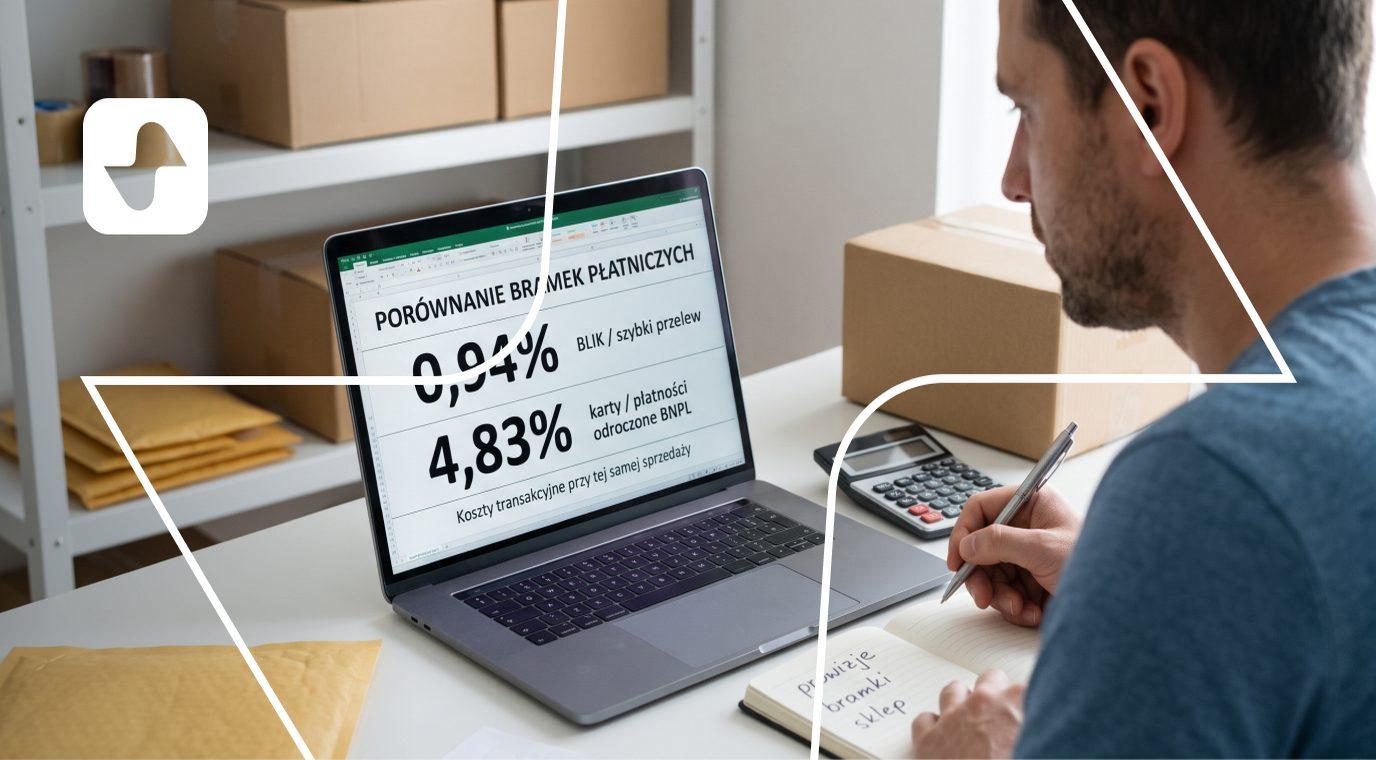
But a seller of e-books, website templates, webinar tickets or small crafts does not have a PLN 162 basket. On a PLN 30 order that same zloty is already 3.33 percentage points — more than the whole percentage rate it stands next to. In offer D a creator with 200 orders at PLN 30 (PLN 6,000 turnover) pays PLN 290 a month, or effectively 4.83% of turnover, though the headline showed 1.5%.
The conclusion is simple: the smaller the basket, the less the percentage per transaction matters and the more the fixed fee does. For a store with cheap products the first figure to check is therefore the zloty amount added to every payment, and the percentage moves to second place.
A subscription reverses the ranking
A subscription works the other way: it is a fixed cost spread over all month’s transactions. At low turnover it weighs a lot; at high turnover it almost vanishes. That is why the ranking of the same four operators changes with the store profile.
40 orders × PLN 80 (PLN 3,200). Cheapest: B, package: PLN 30 (0.94%) Dearest: C, package: PLN 131 (4.08%) Effective-rate spread: 0.94–4.08%
300 orders × PLN 160 (PLN 48,000). Cheapest: B, package: PLN 497 (1.04%) Dearest: D, card: PLN 1,020 (2.12%) Effective-rate spread: 1.04–2.12%
1,000 orders × PLN 160 (PLN 160,000). Cheapest: C, package: PLN 1,683 (1.05%) Dearest: D, card: PLN 3,400 (2.12%) Effective-rate spread: 1.05–2.12%
Assumptions: all payments by one method at the standard rate (in offer D — card; on BLIK D comes out about 5% dearer still), payout once a week, no refunds or disputes, no activation fee. In offer B the reading of the price list was taken where package fee and commission above the threshold add up. In the 1,000-order profile package C beats package B by PLN 46, so under another reading of B’s price list the order may reverse.
A package with a PLN 99 subscription that in a small store was the dearest in the set wins in a large one. At a PLN 160 basket it pays from about 67 transactions a month; at a PLN 30 basket — only from about 160. The operator itself argued a price-list change by saying that at three transactions a day of PLN 150 a package with a monthly fee comes out better. Recalculation confirms that, provided the store sells every day, or about 90 transactions a month. On weekdays-only sales (about 66 transactions) the bill already reverses.
A second thing visible in the table: the gap between cheapest and dearest offer in a mid-size store is about PLN 520 a month, or over PLN 6,000 a year. For a store with PLN 48,000 monthly turnover that is over one eighth of monthly sales — that is the spread between cheapest and dearest price list at identical traffic.
Refund, dispute, payout: costs visible only after a quarter
An offer that on the first transaction looks identical to a competitor’s can diverge at the first refund.
The key question is: does commission on a refunded payment return to the seller? Offer D’s documentation states outright that fees on the original transaction are not returned. On a PLN 160 order the seller refunds the customer the full amount and is left with a PLN 3.40 cost though they sold nothing. In industries with a high refund rate, such as clothing and footwear, that item grows with the number of refunds. Offers A and B declare “PLN 0 for refund handling,” but the price list does not show whether commission on the original payment returns — that must be asked separately.
A dispute is a rare item, but painful. PLN 90 for one chargeback in offer D is 56% of a PLN 160 basket and as much as commission from about 26 ordinary PLN 160 transactions. Three offers in four do not state that fee in the public price list, so its height must be sought in the terms or asked before signing.
Payouts are the smallest item, but depend on habit. A seller who pays out daily because they watch liquidity will, in offer A, pay for about 18 extra transfers at PLN 0.99, and in offer C without subscription — PLN 2 for each of about 22 payouts. That is from a dozen to over PLN 40 a month that the offer headline does not show.
The dearest item has no price: change and exit terms
All the figures above have one limit: they describe price lists as of 22 September 2026. And price lists change.
In January 2026 one of the large Polish operators rebuilt its settlement model: introduced a package with a PLN 99 monthly fee and assigned existing clients to the new packages. The operator assured it had notified them earlier in the panel and that the assignment was to be cost-neutral or favourable for them. In comments under a trade account, though, some sellers wrote they learned of the fee only from the first invoice.
Who was right in the communication dispute cannot be settled from outside. What can be checked is how little the law protects the entrepreneur in such a situation. The Payment Services Act lets parties to a contract where the user is not a consumer exclude, among others, provisions on terminating a framework contract (Art. 33 in connection with Arts. 35–37). An entrepreneur may therefore lack the statutory safety net an individual customer counts on — if the terms exclude those provisions. Then how long termination takes and what exit costs is decided by terms usually accepted with one click at registration.
On top of that comes a commitment hidden in the form of payment. The PLN 29.99 a month package in offer B is priced “on annual billing,” or PLN 359.88 up front. In the small store from the table above that is the cheapest option — provided the store will operate through that year and will not change operator.
Exit cost can also be purely technical: a new integration, rewiring a plugin, testing payment and refund notifications. The more work a change requires, the less often a seller recalculates the bill, even when the price list has moved against them.
At Paymove (https://www.paymove.io/en/checkout) activation and subscription cost PLN 0, the panel, reports and payouts are not charged extra either, there is no fixed-term contract or exit fee, and a payment can be created via REST API with public documentation and a sandbox, without talking to sales.
Comparing payment-gateway costs starts with an export and ends in the terms
The most useful figure in this whole bill is the effective rate: the sum of all fees from the last three months divided by turnover from the same period. In the examples in this text it ranges from 0.94% to 4.83% at headline rates sitting between 0% and 1.6%. The spread is so large because the headline rate describes one price-list line, and the effective rate — the whole bill.
For a seller that yields one practical habit change. Payment-operator offers must be compared like insurance offers: every item, on your own data, including what happens when terms change. And since terms can change even at a large player — as the start of the year showed — real value sits in being able to redo that bill every year and move without a penalty when the result comes out worse. A contract you can leave in a month is therefore worth pricing higher than the commission table alone implies: only with it can an annual price comparison end in something more than irritation.