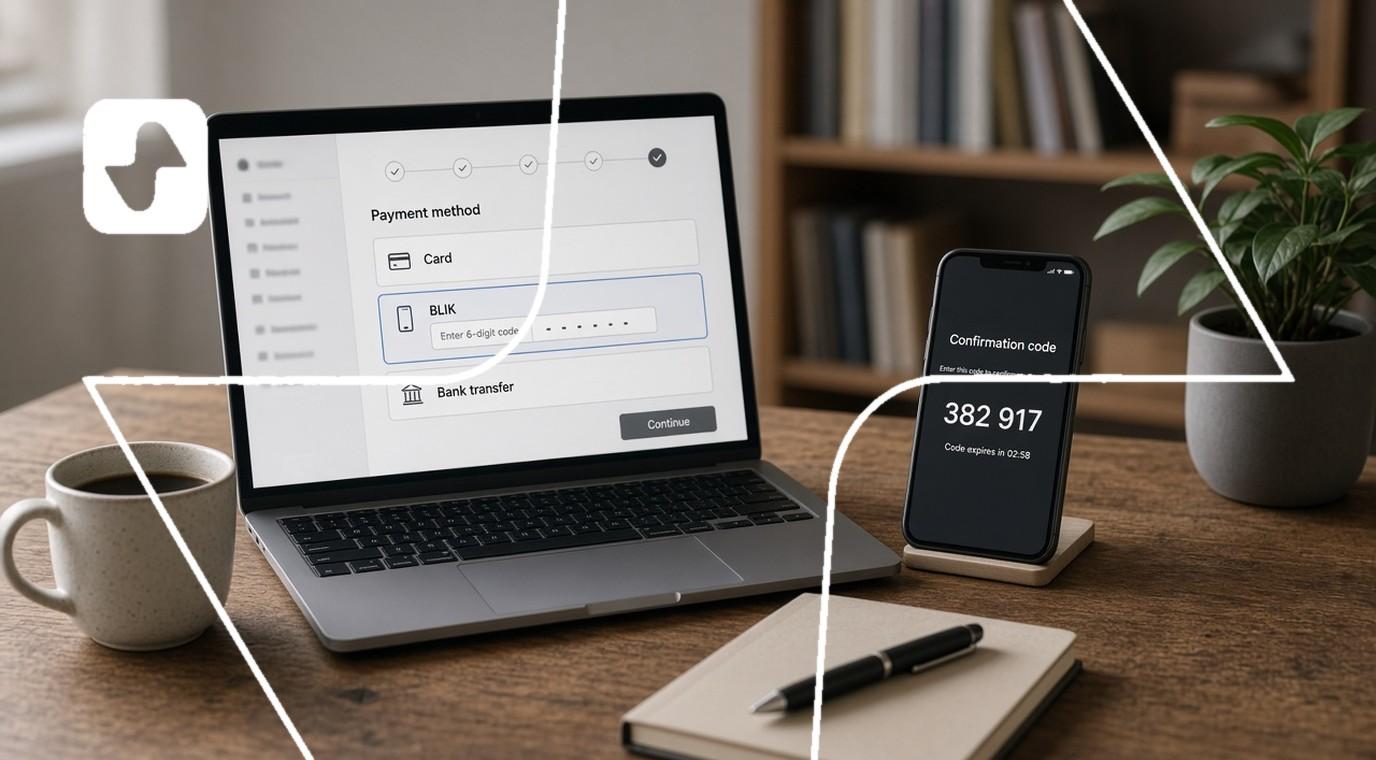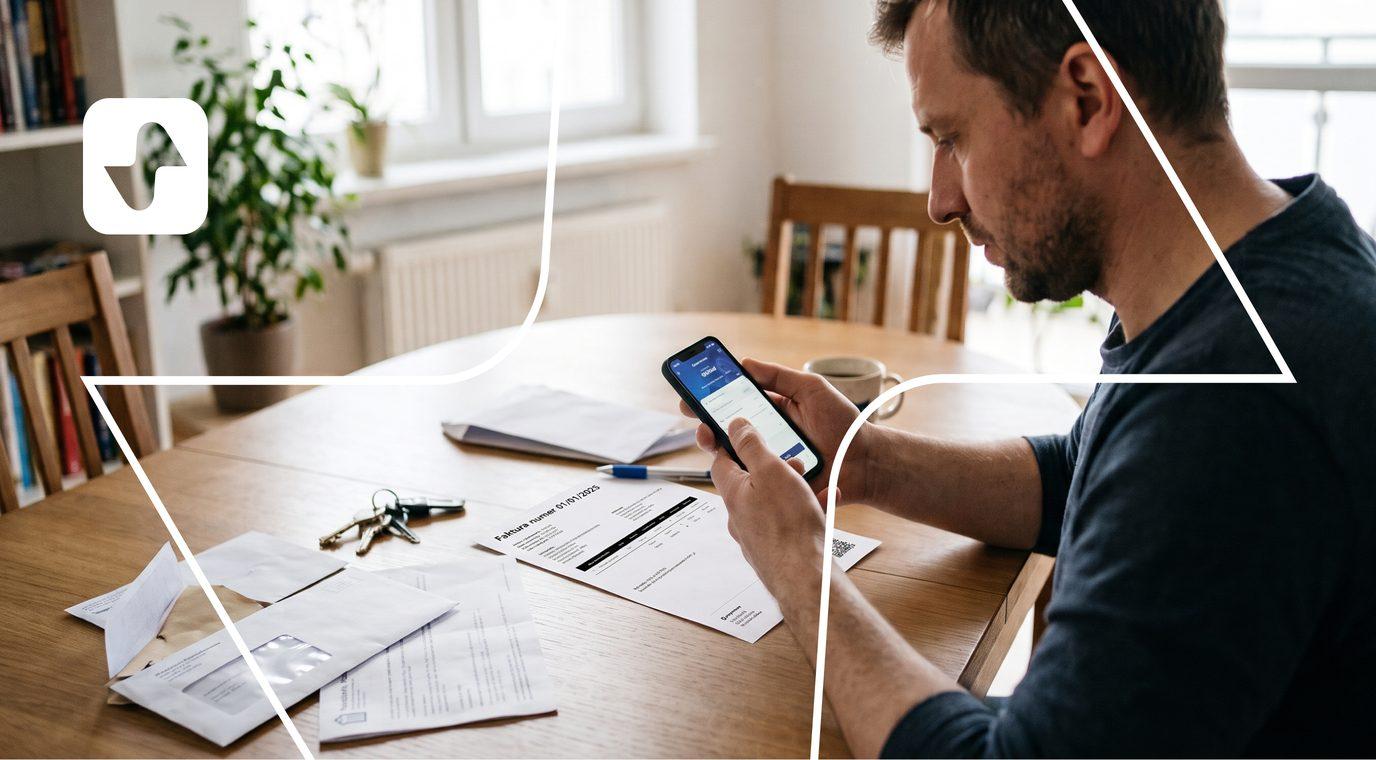
The same person, the same phone, the same week. In an online store they pay with BLIK in two seconds and never see an account number. Five days later they pick up a notice of the advance on management costs, open a transfer form and retype 26 digits, an amount built from several items and a title that must match, or the administration’s accounts will not map the payment to the unit.
The difference between those two minutes is made by the document payment starts from.
Online rent charges: 66% of declarations and the measurement boundary
A Maison & Partners study for the Polska Bezgotówkowa Foundation from August 2026 finds that 66% of people are interested in paying rent and other administrative dues online. The figure alone means little, because declaring interest is the cheapest thing you can say to a pollster.
It gets interesting only at separate subgroup results: in mid-size cities 61%, in large ones 58%. Agglomerations score lowest. The direction runs against the intuition that looks for digital expectations in Warsaw, and for a manager in a mid-size city it means demand does not have to be built there first.
The age mix goes even farther from the circulating thesis: the highest result is the 35–44 group (52%), the lowest 18–24 (38%), with 44% in the 45–54 and 55+ groups. The authors’ comment quoted in the publication explains that last result by the youngest usually not yet paying for housing upkeep from their own pocket. A methodological caveat is needed here, without which these figures lead astray: none of the published subgroups reaches 66%, so subgroups and the overall result answer different questions.
Monika Grabowska, managing director of the Polska Bezgotówkowa Foundation, comments briefly: “The direction of change is clear; digital payments are becoming a natural element of modern resident service.” The foundation’s programme covered by end-June 2026 nearly 4,000 offices and public institutions and nearly 22,000 devices for taking payments. Those are figures about terminals at a counter, and the monthly document landing in a mailbox stays outside the programme’s scope.
The scale we are talking about: how many documents arise each month?
Two GUS figures as of 31 December 2024 (published 16 September 2025): housing communities hold 3,873.2 thousand dwellings, cooperatives 1,897.5 thousand. Together 5,770.7 thousand units. Taking one charge notice a month per unit, which is an assumption here, not a GUS figure, yields 5.77 million documents a month and about 69.2 million a year, issued by entities that in large part have no IT department of their own.
Rates are rising fast and that is already in GUS: the advance on management costs in communities PLN 4.38/m² in 2024 versus PLN 2.94 in 2018, or nearly 49% more in six years. The operating charge in cooperatives PLN 5.52/m² versus PLN 3.39, or just under 63% more. What does that mean in zloty per unit? GUS gives usable floor area of the stock in the same table: 204,137.4 thousand m² in communities and 93,187.8 thousand m² in cooperatives. Dividing by dwelling counts gives an average unit of 52.7 m² and 49.1 m², and multiplying by rates about PLN 231 and about PLN 271 a month.
For operations in administration another size of the same thing matters more. In the NBP study “Payment habits in Poland in 2023” rent is 12.9% of volume of recurring payments and 30.9% of their value. An average rent payment is therefore 2.4× higher than an average recurring payment overall. That is the dearest item in the category and at the same time the one where the payer gets the least technical help.
Poland’s largest invoicing reform bypassed this document
KSeF is mandatory from 1 February 2026 for taxpayers whose VAT sales exceeded PLN 200 million in 2024, and from 1 April 2026 for the rest; everyone must receive invoices in the system from February, and through 31 December 2026 a PLN 10,000 monthly limit applies to invoices issued outside the system.
And here enters the distinction that decides everything on this topic: the duty covers business-to-business relations. Settlements with natural persons not running a business stay outside it. A cooperative will therefore issue in KSeF an invoice for a commercial unit or a garage for a firm, and the document for a residential unit’s resident can still be printed and dropped in a mailbox. Nobody has publicly counted those two groups’ share of volume, but the mix of residential to commercial units in community and cooperative stock suggests the document exempt from the duty accounts for most of the mailing.
The cost of the reform, meanwhile, lands in the rent. A community in Gdańsk raised management fees from January 2026 by over 17%, naming KSeF go-live as one cause (portalsamorzadowy.pl, 14 February 2026). In that community residents therefore pay extra for a system that does not handle the document that reaches them. That is one of the cleaner examples of how digitisation misses the place where friction is greatest.
Transfer: 60.9% in charges, 7% in e-commerce
Two readings of the same instrument in two worlds. In recurring payments (NBP, 2023 data, published October 2024) credit transfer has 60.9% of volume and 63.6% of value. In e-commerce in Q1 2026 transfers overall fell to 7% of transaction volume, with BLIK around 72% and cards above 21% (NBP data in a cashless.pl brief, 21 July 2026).
The comparison needs caution, because these are different populations and periods, so subtracting the shares would be an abuse. The direction is readable, though: in a channel where payment was designed from scratch, manual transfer fell to a margin, while in housing charges it still holds the skeleton of the whole process.
The same NBP report also shows that residents change behaviour as soon as they get the option. In recurring payments cash fell from 20.9% of volume in 2020 to 10.8% in 2023, and BLIK’s share rose from 0.4% to 10.1% — over 25× higher. In utility bills BLIK already has 12%, in phone and internet 15%.
Arrears grow slower than rates, and that shifts the burden of proof
Housing-charge arrears stood at PLN 6.90 billion at end-2022 versus PLN 6.47 billion in 2018, or +6.6% nominally over four years. Rates from the previous section rose many times faster in the same stock, though GUS gives them in a longer window to 2024, so I do not pair those two paces. What shows without a common deflator: the arrears amount barely moved, and rates went up by several dozen percent.
A second pair from the same GUS data says more than the amount. Share of units in arrears: communities 15.3%, cooperatives 25.9%, or 10.6 pp difference between stocks, with about 46% in municipal stock. Community and cooperative handle similar amounts in similar settlement technology; what differs is organisation size, ownership structure and how they communicate with residents.
The resident portal ends at the balance
Cooperatives and managers have for years rolled out eBOKs and resident portals where balance and utility settlement show. That is a real information-side improvement, while payment itself usually still ends in retyping data into banking or moving to an external form, and the issuer learns of the payment only when someone maps a statement line to a unit. The portal shows how much to pay. The payer still makes the transfer.
Paymove enters this category with the DocPay line and touches only that one layer: a QR code on a bill, notice or demand that after scanning opens a payment page with amount, title and payee filled in, payment by BLIK, Google Pay or Apple Pay — all without an app, without registration and without changing the invoicing system, with a real-time view of which document was paid.
Written consent to leave paper
A government draft amending the Act on ownership of premises (UD312, Ministry of Development and Technology, published January 2026) puts electronic information flow on a par with written and allows delivering resolutions electronically. With one condition: electronic delivery requires the unit owner’s written consent. The draft was in the Standing Committee of the Council of Ministers on 1 October 2026, has not reached the Sejm, and entry into force was planned three months from promulgation, so that calendar is clearly longer than the calendar of rate rises.
From that follows something a community board can do earliest and cheapest, with no go-live and without waiting for the statute. Consents to electronic contact are collected most smoothly where owners already sign an attendance list — at the annual meeting. Whoever leaves the meeting with a full set of e-mail addresses and consents has an open path to every later solution, from a plain PDF in mail to a payment code on the document. Whoever leaves without them will next year still be weighing digitising settlements while sending paper to mailboxes.
The next meetings in most communities will happen by end of Q1. A signature on the attendance list is, in this whole puzzle, the only item technology does not speed up.