There is one number in online retail quoted more often than any other, and it has barely moved for twenty years. Seventy percent of carts are abandoned. Every conversion deck, every UX webinar and every message from a tool that promises to recover those carts repeats it.
Less often comes the question of where that number comes from and which part of it the store can actually own. If most cart abandonment is a decision the merchant could not have stopped, the playing field for optimisation is much narrower than the sales pitch. And if the fixable remainder concentrates in one place in the flow, it is worth knowing which place before spending budget on everything else.
Seventy percent counted since 2006
The benchmark comes from Baymard Institute’s compilation, which averages 50 cart-abandonment studies. The result: 70.22%. The most interesting part of that set is the time range — from 2006 through August 2025. The average therefore spans the era before BLIK, before Apple Pay and before the smartphone as the main shopping device. The figure pasted into checkout decks in 2026 is older than most of the stores that quote it.
A second finding from the same research weighs more. In the institute’s quantitative measure, 42% of people who abandoned a cart gave the reason “I was only browsing / not ready to buy”. The authors state plainly that this share is practically unrecoverable, because the cart was acting as a wishlist. A checkout process that was too long or too complicated accounted for 17%.
Let’s convert that to one hundred started carts, because that is the scale at which a store makes decisions. Seventy drop out. Of those seventy, about twenty-nine are browsing, and about twelve are a process that was too long. I am doing this arithmetic myself — it is not in any report — and it assumes the reason mix is the same in every store, which is probably false. The order of magnitude stays readable anyway: the fixable part sits closer to twelve carts in a hundred than to seventy.
That ratio looks bad only until you add a reference point. The same institute estimates that improving checkout design alone gives large stores an average 35.26% conversion lift. Twelve carts in a hundred is little against seventy and a lot against what another campaign tweak usually squeezes out.
The Polish measure says 55 percent — and measures something else entirely
Fresh domestic data is from early October, from Minds & Roses for Mastercard: 55% of shoppers abandoned a cart at least once in the past year.
Putting those 55% next to the global 70.22% is tempting and wrong. The first figure measures people; the second measures carts. 70.22% is the share of abandoned carts among all started carts, while 55% is the share of people who experienced it at least once over twelve months. The Polish result mainly says one thing: 45% of shoppers did not interrupt a purchase even once all year. How often the remaining 55% abandon, the study does not say — and with roughly a dozen online purchases per person per year, the gap between “once” and “every time” decides the whole account.
The value of that study sits elsewhere than the headline rate. It asks about the moment. 36% of abandoners did not get past choosing delivery, 34% past choosing a payment method, and 31% past a requirement to create an account. Three screens that in a typical store follow each other within two minutes therefore collect almost all of the checkout drop-off. The reasons are concrete too: 30% pointed to a missing preferred payment method, 24% to a payment process that was too long or too cumbersome.
Shipping cost is the usual culprit. So why do people drop off at payment?
The stock answer to abandonment in Poland has strong support in the data. In the “E-commerce in Poland 2026” report (Gemius with IAB Poland, CAWI of 1,874 internet users, of whom 1,768 shopped online, 14–22 July 2026) 47% of shoppers change store or abandon because of shipping cost or no free delivery, 44% because of product price, and 30% because of long delivery times.
Both lists are correct and describe two different things. Ask for a reason and you get price, because price is the rationalisation easiest to give an interviewer and the one the abandoner believes. Ask for the moment and you get process, because the moment is visible on screen and can be pointed to. A store that reads only the first list optimises the free-shipping threshold — an expensive move, because every order pays for it in margin. A store that reads both still has a second stretch that is much cheaper to fix.
Meanwhile the cost of waiting grows on its own. Online’s share of retail sales was 8.9% in July 2026 versus 8.6% a year earlier, and online sales themselves rose 9.0% year on year while total retail grew 3.9%. The channel grows more than twice as fast as retail overall, so the same checkout drop-off rate costs more in real terms every year.
Abandoned carts in Polish e-commerce have one local parameter: 53 percent pay with BLIK
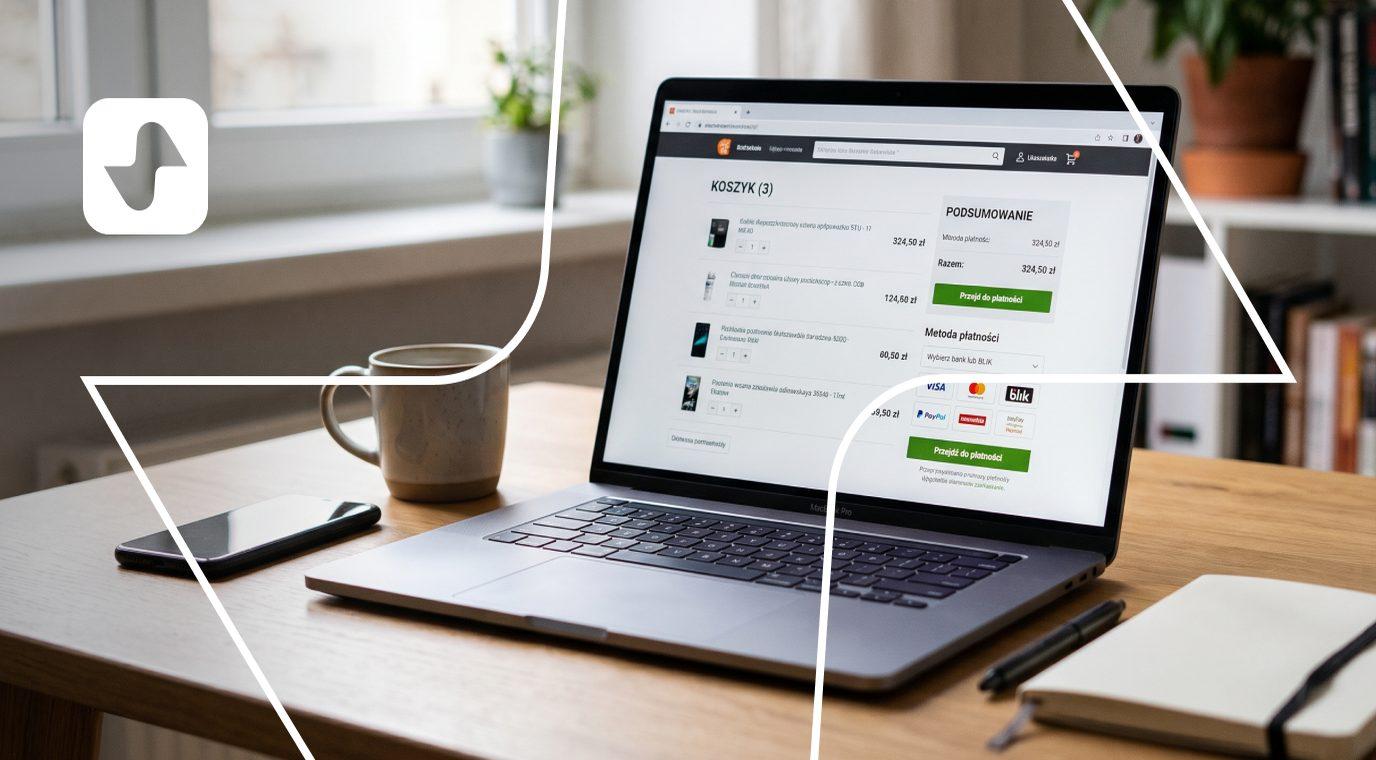
The payment mix here differs from the studies behind the global average. According to the same Gemius report, 53% of shoppers most often pay with BLIK, 13% with a pay-by-link bank transfer, and 10% with a card. 67% of online shoppers used BLIK in the past year, and for more than half it is the primary method.
Now the figure that sits next to that awkwardly: 31% of respondents in the Minds & Roses study paid by card online in the past year by typing full card details by hand. Among people who abandoned a cart, 30% named a missing preferred payment method as the reason. The dominant method and the most cumbersome method therefore appear in the same cart, usually on the same screen.
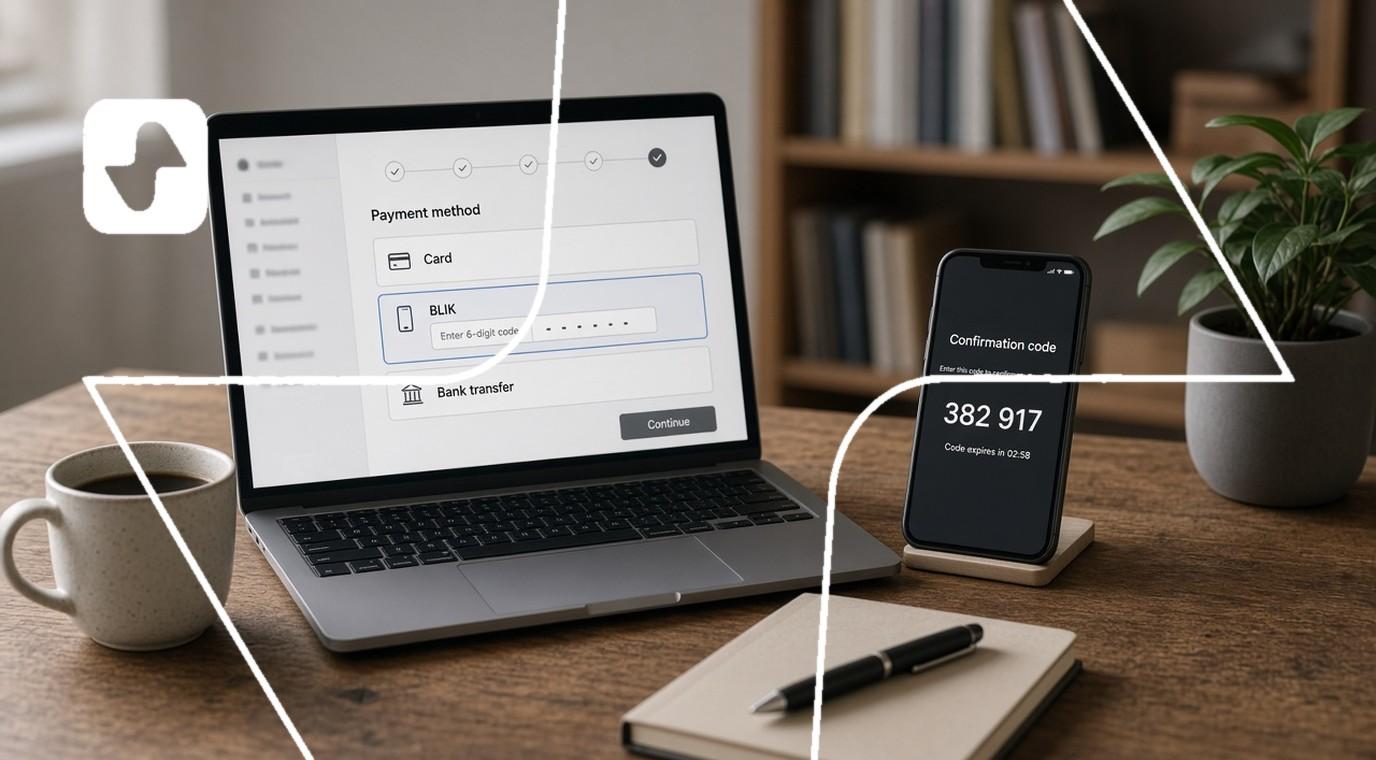
The technical consequence of that mix matters more than the ranking itself. The method used by more than half of the Polish market does not require the shopper to leave the store’s page. Confirmation still happens in the banking app, so an intermediary page adds nothing to that path except one reload on a foreign domain.
Eight percentage points with no method description underneath
There is no hard, independent measure of that single step on the Polish market. There are operator figures, and they should be read exactly as you read a manufacturer’s figures about its own product. An analysis of more than 70,000 transactions from stores on one storefront platform, from February and March 2026, reports an average conversion lift of 8 pp for BLIK paid without leaving the store — highest in apparel and footwear, lowest in health and beauty and in home and garden. For cards the gap is 12 pp at about a 7% card share in the sample. Average order value in that set is PLN 220.
What that analysis lacks is a description of the baseline. It is unclear whether the same stores were compared before and after a change, or different stores against each other — and those are two entirely different measurements: in the second case the result says as much about which stores adopt newer integrations as about the integration itself. Without that, 8 pp is a lead, not proof.
A modal moves the redirect one step and does not remove it from every payment method
The technical side is less spectacular than the promise of “payments without leaving the store”. On our side the path looks like this: a browser widget opens checkout in a modal — a frame embedded on the merchant’s page — and redirect remains a variant switched on with a single parameter. We create the payment on the server side, and a signed webhook decides whether the money actually arrived. In the docs we treat the browser UI event as a signal for the visual layer, nothing more.
We list the limits in the same documentation, and those limits decide how much of the promise remains. Some banks in the pay-by-link option, and PayPo, still open their own window. Apple Pay in a modal requires domain verification with an Apple file on our side, and without it it will not work. The modal itself requires HTTPS on the store. For BLIK and wallets the path stays on the merchant’s domain; for a traditional transfer it leaves it — and that is exactly the real scope of the change. The slogan “payment without leaving the store” promises more at this point than can be delivered.
Our price list for this line is public and has one feature that matters for the abandonment account: we take 1.29% per transaction, with no activation fee, no subscription, no fixed-term contract and no exit fee. We do not charge a fixed fee per transaction, so the effective rate does not depend on basket size. With two-part price lists (“percent plus amount”) it is the opposite, and at an average order around PLN 220 that difference shows up precisely in low-basket categories.
The recoverable share of abandoned carts is small — and that is exactly why you need to measure it
A store that wants a decision out of this needs three numbers, and none of them will be found in someone else’s report.
First: how many shoppers reach the payment screen and how many leave it. That is the only stretch where purchase intent is already confirmed, so every abandonment here weighs more than ten abandonments on a product list. Second: how that rate splits across payment methods. If BLIK behaves differently from a bank transfer, the answer to the redirect question sits in your own data and no external analysis replaces it. Third: how many orders are lost between confirmation in the banking app and return to the store, because that is exactly the fragment of the path the store hands to someone else — and it is usually missing from any internal report.
Only after those three measurements does a debate about a modal, a plugin or an SDK make economic sense. Before them it is a technology choice under a thesis nobody has tested.