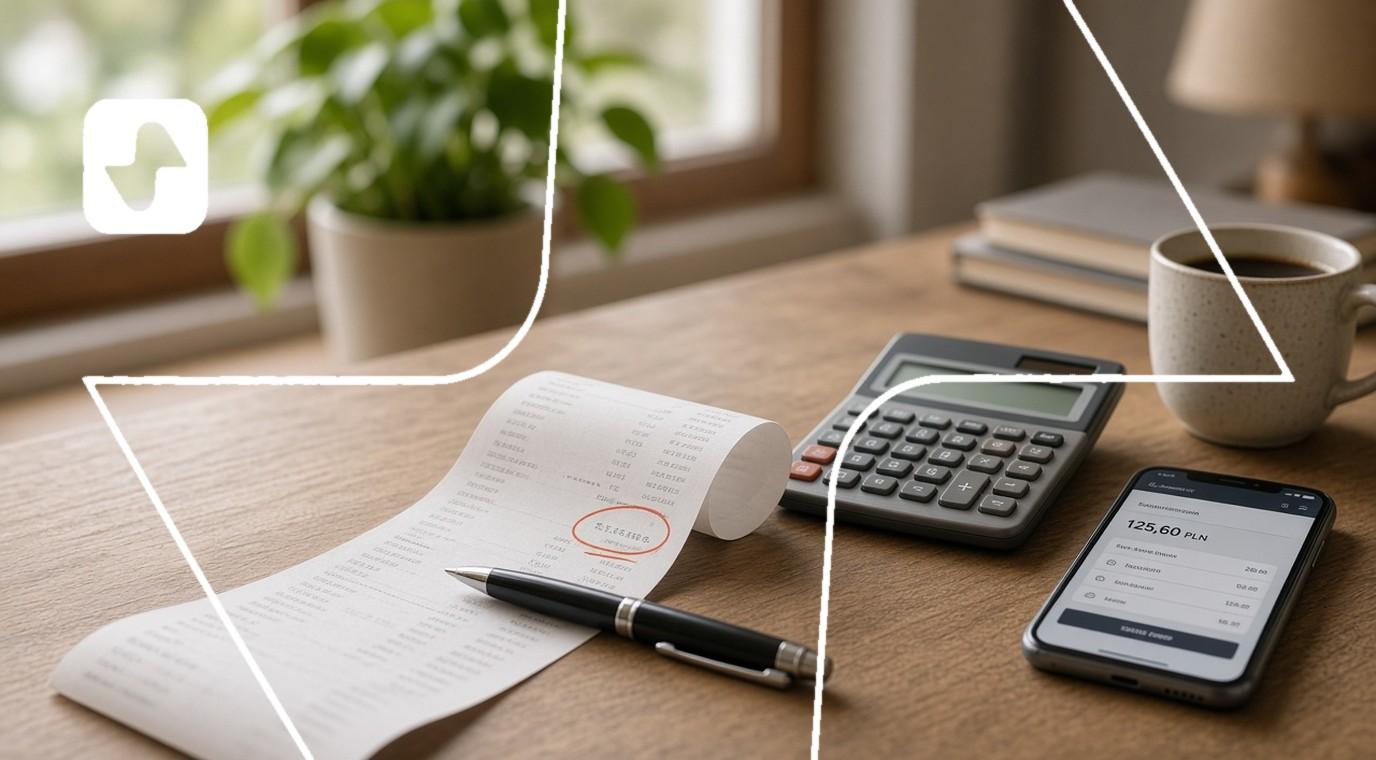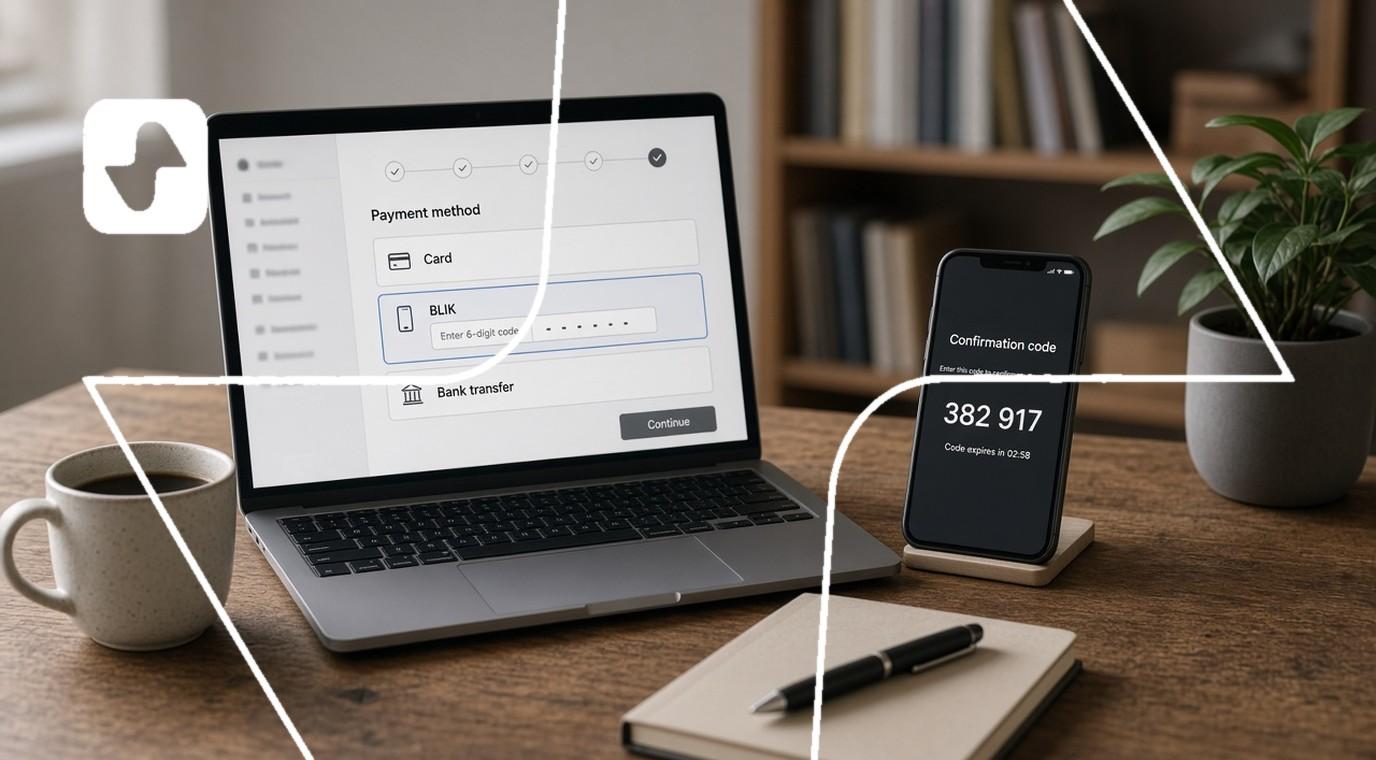
Product categories. Stock levels. Package dimensions. Shipping rules. That many fields get filled in the first quarter-hour of setting up an online store. In a service firm none of them will be filled. A physiotherapist who sells a visit, a five-session package and an online consultation enters zeros.
Those fields are not there by accident. An online store was built as a tool for someone who has an assortment and must manage it. A service seller has a price list and a calendar. Before they sign the first contract there is one question the platform price list does not answer: how much is that amount per sold visit?
How many firms does this even cover?
Scale comes from two GUS tables rarely set side by side.
First: in Q2 2026 Poland had 2,896,481 active enterprises, of which 2,779,281 were micro-firms — 96% of the market. The entire positive quarterly result was carried by them (+1.8% year on year), while small, medium and large firms recorded declines. The growth direction is also readable: health +13,090 entities, administration +12,748, professional services +10,537. Trade in the same period lost 19,008 firms.
The second table says how that market sells. In 2024 18.3% of enterprises ran electronic sales, of which 12.9% via their own site or app and 10.2% via marketplaces. An annotation is needed here without which these figures mislead: the GUS study covers only enterprises employing 10 or more people. Micro-firms — those 96% of the market — are not in the sample.
So: the fastest-growing part of the Polish economy sells services, and the only public measure of online sales does not cover it. For someone designing a payment offer that white spot is 2.78 million entities in size.
A subscription converts to commission. Just divide
Price lists of store platforms and payment operators look incomparable, because some count in zloty a month and others in percent of transaction. They can still be paired without inventing anything: three published figures suffice, the third being the average basket in Polish e-commerce.
The entry plan of one of the largest Polish store platforms costs PLN 299 net a month at the regular price (PLN 29 on a promotion that applies when paying up front for the first 12 months). Transaction commission in a major Polish payment operator’s price list is 1.29% plus PLN 0.30.
Before we divide anything, that thirty groszy must be priced, because without it the comparison measures only half the tariff. Its weight depends on basket size. At the average transaction in Polish e-commerce, about PLN 180 (NBP data), the fixed fee adds 0.167% of value, so the 1.29% rate becomes effectively 1.46%. At a PLN 50 basket it becomes 1.89%, because the same thirty groszy then weighs 0.6% of value.
Only now does dividing make sense: PLN 299 equals commission on PLN 20,526 of monthly turnover at a PLN 180 basket. Counting the percentage rate alone, omitting the fixed fee, the threshold would be PLN 23,178 — 11% higher — and that is exactly how the short-cut bill looks.
That is the whole content of this comparison. A seller who puts a little over PLN 20,000 a month through the online channel pays for the subscription as much as commission would cost — and from that threshold up the subscription pays for itself, because the amount stands still while turnover grows. Whoever does less pays more for the shelf than for the sale.
The same arithmetic applies to payment operators’ own subscription plans. One offers an entry plan at PLN 29.99 a month on annual billing (PLN 359.88 a year), with zero commission up to PLN 5,500 monthly turnover and 1.1% above. At PLN 5,500 turnover that subscription costs 0.55% of turnover. At PLN 800 — 3.75%. A sevenfold spread, in one plan, at an unchanged price list.
So a fixed fee has its percentage rate. Its height depends on the seller’s volume, so it cannot be printed in the price list — and exactly at that point the price list stops telling the whole truth about cost.
And how much does the rest of the store cost?
The subscription is the smallest item. A WooCommerce go-live at a Polish agency starts from PLN 8,000 net, and technical care from PLN 979 net a month. A three-year total cost of ownership model one of them published in September 2026 gives PLN 63,280 net, of which care alone is PLN 36,000 — 57% of the whole. Annually that is PLN 21,093.
Worth converting to the unit the reader of this text earns in. According to the Useme Index the average value of one freelance job in Poland is PLN 1,576 in copywriting, PLN 1,610 in social media, PLN 2,004 in design and PLN 2,050 in SEO. Annual store cost in the agency model equals 13 copywriting jobs — before anyone has paid for the first one.
The second cost is higher and has no invoice. An online store needs assortment, photos, descriptions, terms and a returns policy. For someone who sells three items that is several days of work after which sales will not rise by a zloty — fields get filled because the tool requires them.
How such stores end is shown by a Dun & Bradstreet analysis: 52% of e-stores with revenue under PLN 10 million are in poor or very poor financial condition, while in the PLN 10–250 million band 88% are rated good and very good. A caveat without which that figure does not work: the analysis rests on KRS filings, so it covers companies and omits sole traders — exactly the group discussed here. Median net profit of a statistical Polish e-store in the same study is PLN 250,000 a year at average profitability of 2.7%.
There is also an item paid for someone else’s platform. A global store platform that prices in zloty in Poland takes PLN 79 a month on the basic plan with annual billing — and 2% additional transaction fee for using an external payment gateway. For a Polish seller who wants to take BLIK that is 2% on top of the operator’s commission: 3.29% in total instead of 1.29%, or two and a half times more. That fee is designed for sellers for whom it still pays. A micro-firm with three items on the price list is not in that group.
Payment statistics say something uncomfortable
Now the side that counters this thesis. According to NBP data gathered by cashless.pl, pay by link accounted in Q3 2025 for 2.2% of volume and 5.2% of value of e-commerce transactions in Poland. In 2020 it was over 40% of volume and over 46% of value. An eighteenfold share drop in five years. BLIK today has 69% of volume and 60% of value.
Two notions must be separated here, because they sound alike and concern different things. “Pay by link” in NBP statistics means a payment method: redirect to the bank and a filled transfer form. A payment link as a sales channel uses underneath the same infrastructure as store checkout — BLIK, Apple Pay, cards. Statistics measure the method, not the place where the transaction started.
What is interesting is what comes from dividing those two shares by each other. 2.2% of volume at 5.2% of value gives an average transaction of about PLN 425, against an all-market average of about PLN 180 — two and a half times higher. What explains it NBP does not publish, because it does not split data by seller type. What remains is the fact: this form of payment holds where amounts are larger than the average basket.
A second figure from the same shelf. BLIK in the first half of 2026: 1.6 billion transactions, PLN 244.8 billion, 21.6 million active users. Broken down — e-commerce payments 766.7 million transactions for PLN 124.5 billion, phone transfers 393.6 million for PLN 67.6 billion. Average transaction PLN 162 and PLN 172 respectively. A P2P transfer is on average 6% higher than an online-store purchase. The company does not publish what share of phone transfers is paying someone for a service versus splitting a restaurant bill, so no conclusion about off-store sales scale can be drawn from that.
The order that comes out of this arithmetic
Every threshold in this text requires one input: monthly turnover in the online channel. Whoever has it behind them will calculate everything in thirty seconds and choose correctly.
The trouble is that in this category that figure usually does not exist yet. The physiotherapist from the opening does not know how much she will sell online, because she has not sold yet, and a subscription price list asks her to know on the day of signing and will bill PLN 299 also in a month when nothing comes in. A per-transaction fee does not require that forecast: at zero turnover it costs zero, and it discloses its rate up front and holds it regardless of volume.
Hence the reverse order of the usual. First a channel that will start generating the first real figure and will not charge for it up front. Then the store decision, already taken on data. The PLN 23,000 monthly turnover threshold can then be compared with something that actually passed through the till, not with an expectation that on signing day had nothing to rest on.